 | CAPE BRETON ISLAND |
SYDNEY
So at Channel Port-aux-Basques I boarded the Caribou and we left Newfoundland behind.
There aren't too many photographs of life on board the Caribou for the simple reason that seasoned traveller that I am, and with it being a 9-hour crossing, the first thing that I did was to find a comfortable corner and the second thing that I did was to settle down to sleep. Not that it was easy of course but it's always a good idea on a long sea crossing where the sea conditions are likely to be, well, exciting.
As an aside, in a prominent position on board the ship was a notice to the passengers displaying a list of what counts as "disruptive behaviour". One of those things was "sleeping on the floor". I'm not quite certain how it is that this can be classed as disruptive behaviour - in fact any parent of a disruptive toddler will tell you that the aforementioned going to sleep anywhere is one of the things for which they prey. What I think it means is that people sleeping on the floor are disrupting the income-generating activities of Marine Atlantic by not paying for a cabin or a reclining seat.
I'm not quite sure of what they can do if someone disobeyed this kind of instruction. Waking a sleeping person is depriving him of his Human Rights, as many recent court cases involving the use of torture by the British and United States governments have confirmed, and I imagine that casting someone adrift in an open boat in the Gulf of St Lawrence, middle of winter or not, will be similarly classed.
I'm becoming less and less enamoured with western society, as you can tell from my writings, when these kinds of petty rules seem to be becoming more and more prevalent. Next time anyone tells me about the freedoms that exist in the west, they will receive a smack in the mouth and no mistake.
But to change the subject ever so slightly, I had noted that the survivors of the torpedoing of the previous Caribou on 14th October 1942 in the Gulf of St Lawrence were in the water awaiting rescue for 16 hours, and it was the minesweeper Grandmère that rescued them. I had also noted that it was the Grandmère that was accompanying the Caribou in the crossing. I had always thought that it was strange therefore that it took the Grandmère 16 hours to find and rescue them. What kind of accompaniment had it been providing?
I discovered the answer to this in volume I of Clay Blair's Hitler's U-Boat War: The Hunters 1939-1942
Mind you, why the Grandmère could not have left the attack to the air and surface forces that had turned up in response to Grandmère's signal and gone to rescue the survivors at an earlier moment is something that has never been explained.
And so a lesson for you - whenever you find yourself on board a maritime vessel, always carry a bar of soap in your pocket. That way, if you happen to fall in the water you can wash yourself ashore.

Its impossible to sleep on any kind of long-distance ferry once land is sighted because the crew suddenly spring into action. Bells clang and whistles blow, and of course that sets off all of the kids. All those people who are awake are overwhelmed with their own kind of excitement as land is sighted.
I had a stroll out on deck and took an early-morning photograph of our destination. This is the entrance to Sydney Harbour and over there is the town of Sydney Mines.

I had a stoll across to the other side of the Caribou and there on the eastern side of the bay are the towns of New Victoria and South Bar, with the bright lights of Sydney away in the background, reflected off the clouds. It was quite early, as I seem to remember.
Actually, I'm quite impressed with these two photos. I spent a good deal of money on a decent camera
I should maybe mention that the images that you see on these web pages are 800x533 reductions, compressed to 50% and hence about 125kb, of images of 4288x2848 and in the region of 5mb. Anyone who would like to see a full-size high-quality image needs to read this section.
One of the things that I was going to do now that I had arrived was to go for a wander around Sydney. I'd been here before, in 2003 but that was when I was recovering from a serious illness and I wasn't particularly in a sightseeing mood.
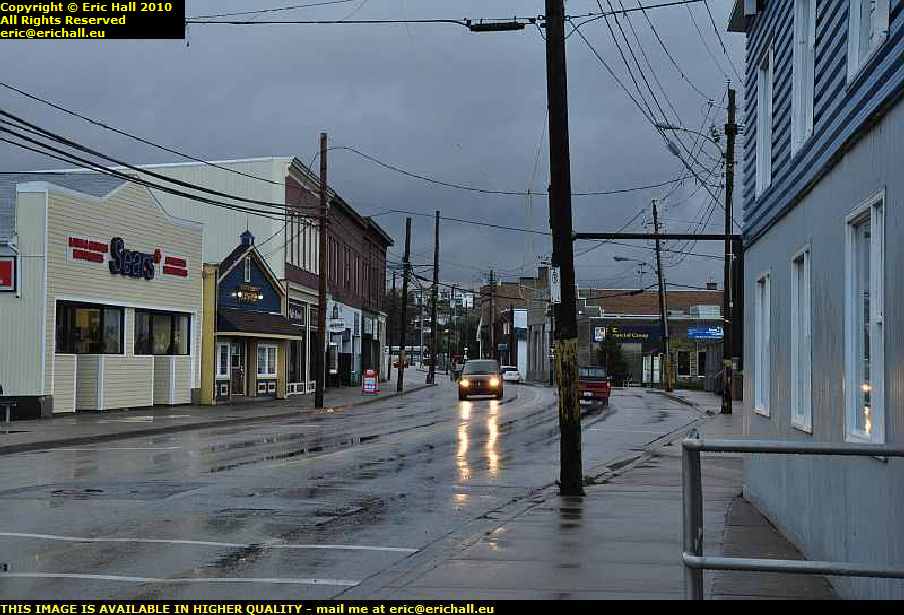
So welcome to Cape Breton Island. And isn't this just how I remember it the last time I was here, just precipitating down with rain? - "Your memory has indeed gone - it was quite nice when you were here then" ...ed".
And just to prove to future generations that I did indeed make it here this time, once I had fuelled up - I'd been running on fumes for the last while thinking that fuel would be much cheaper here than on Newfoundland but in actual fact it wasn't - I went for a wander around. This is North Sydney and Main Street, if my memory serves me correctly.

Main Street took me round and back to the Northumberland Ferry Terminal, which is where the Newfoundland Ferry hangs out when it's at home. Just across the road is a suitable Tim Horton's and whilst in the queue for a coffee I could take a quick snap of the Caribou, with another ship in the foreground.
I have to mention it that just a matter of a couple of weeks after my crossing the Caribou was laid up in the harbour, having been replaced by a more modern ship that Marine Atlantic had dug up from somewhere else. I don't know whether or not it was the effect of having me on board that caused the change. Maybe the crew mutinied or the passengers refused to embark or whatever.
The Joseph and Clara Smallwood was also replaced at this time by the way and so today's travellers will have a new fleet of ships to sail in. Watch out for the Caribou and the Joseph and Clara Smallwood receiving a change of name, maybe to the Domestos and the MS-DOS and resurfacing - "thats an unfortunate turn of phrase" ...ed - in the Greek islands. That's the usual fate of redundant and time-expired mainstream ferries in Europe.
Having dealt with all of this it was onto the Expressway and onwards to the town of Sydney. And just where you turn off the Expres-way to come into the town there's now a roundabout. They are starting to become boring in North America these days. It seems to be the latest fashion and every town seems to have one now. It was so much fun all those years ago when you could drive around for a fortnight and never ever find a single one of them.

First thing that you have to do when you arrive in Sydney is to go to find the harbour and once you have found the harbour you need to go to find the bridge.
This is the Sydney Harbour Bridge, so I was told, but do you know what? In real life it looks nothing like it does on the telly. The sunken ship here in the foreground certainly gives it some added interest.
There are railway lines over the bridge, and I think that this might be part of the Cape Breton and Central Nova Scotia Railway, although I didn't see anything that could confirm this. If it is that line then it is the one that runs over the Canso Causeway to connect with the Canadian National line at Truro. There is however another private railway here - the Sydney Coal Railway, that runs from the coal wharves in the docks out to the coal-fired power station at Lingan on the coast.
A brief scrutiny of the railway track would suggest that it isn't seeing a great deal of traffic these days, which is a shame given the investment in infrastructure and the high cost of road traffic.
There's no passenger service here either, which I consider to be bizarre. "Cost-cutting" was the excuse given for the withdrawal of the service back in the 1990s, but I can't see what costs there are that need to be cut. The infrastructure of the line is in place and being paid for by the freight haulage fees. All we need is a twin-car multiple unit with a driver-conductor running out to Truro and back to connect the ferry from Newfoundland with the train to Montreal, with all of the pre-booking done via the internet.
That's not going to cost very much at all but it's typical of railway companies and Governments the world over, who suffer from a very short-term vision where railways are concerned. No-one in the railway employment has any proper marketing skills these days, and no-one makes any plans for the future.
But that's nothing new, unfortunately. In Wales back in 1954, the Denbighshire County Council had called a meeting of all interested parties to discuss the situation in the rural areas of the County, where the British Transport Commission's railway lines were threatened with closure due to competition from the British Transport Commission's bus companies. A councillor asked why it was that rail fares could not be reduced to attract more passengers onto the railway. A certain Mr. Fisher helpfully replied that
"it would deflect ... passengers away from the road"
The helpful Mr Fisher was the local traffic superintendent for the Railway company.

I managed to find Sydney Harbour too, but then this doesn't look much like I was expecting. At least there was a ship in it however, but I couldn't make out its name. I didn't recognise the owners' livery either, so that isn't much help.
I have heard however that this is quite a popular port of call for shipping from all over the world, and mariners yearn to retire to this particular town. It's quite a well-known fact that there are sailors the world over who are keen to discharge themselves in Sydney after a long sea voyage.
And while we are on the subject, do you know which of these two cities is nearer to Sydney by sea? Rio de Janeiro or New Orleans? The answer, surprisingly, is Rio de Janeiro. It just shows you how distorted are the projections of this part of North America when taken from a globe and put on paper.
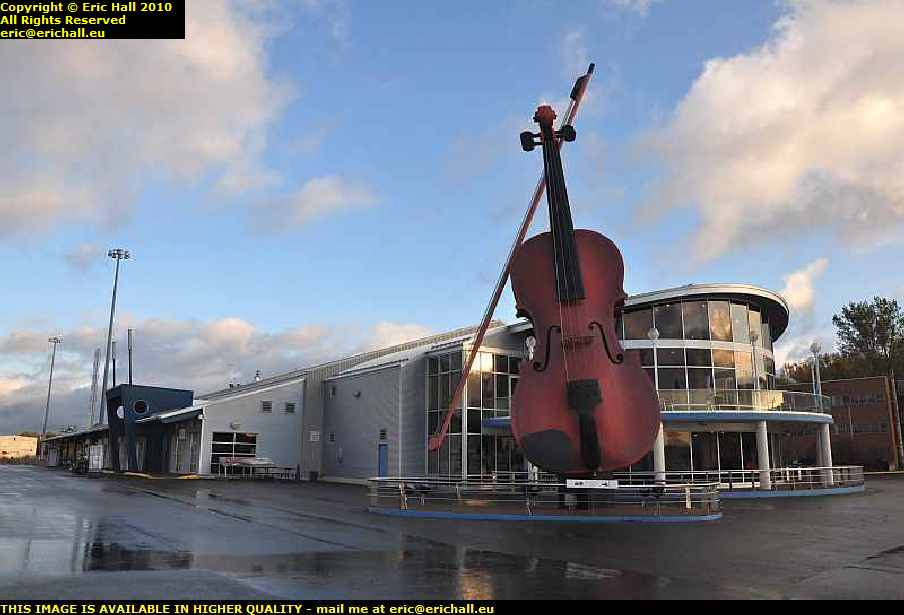
I couldn't find anything that looked like the Sydney Opera House either. This is the nearest thing that I could see. You can however say with confidence that someone has been on the fiddle around here.
Someone said that this is the largest Ceilidh Fiddle in the world, and I would love to meet the man who plays it. But we aren't all that far from Englishtown and the home of Giant MacAskill - I wonder if it has anything to do with him.
That reminds me of when I used to be a coach driver all those years ago, and on one voyage I had to stay at this awful place called "The Fiddle". And a more-aptly named place there never was. It certainly was a vile inn.

There was a really good view back into the town from the plaza of this Concert Hall, and you would have been been able to see it so much better had it not been for the fact that the early morning sun (yes, the rain has stopped and it looks like it might be clearing, as you can see) was full-on into the lens of the camera.
The size of the typical merchant ship has increased considerably over the last 50 years and so many of these smaller port facilities have been closed down, replaced by new facilities further downstream. Sydney is no exception. Coming here 50 years ago, you would have seen a hive of waterside activity. 20 years ago though, you would have seen nothing but desolation and decay.
But back to the weather again (remember that I'm British) this hurricane and torrential downpour of rain have suddenly stopped, just like that, and the sun's come right out now. I was told when I was in Toronto that if you don't like the weather in the Maritime Provinces, don't worry - it'll change in 5 minutes, and I think that they might be right about that.
It's rather like the Auvergne in fact where I live . There, the weather forecast is easy. All you do is drive a couple of kilometres to the top of the Font Nanaud. If you can't see the Puy-de-Dome from there then it's raining. If you can see the Puy-de-Dome from there then it's going to rain.

Now someone once said, and he was from around these parts too, that the town could not be considered to be beautiful, but having had a nosey around of my own this morning, I have to say that I have seen dozens of places much worse than this on my travels.
Mind you, he was talking maybe 30 years or so ago when Sydney was home to one of the world's largest steel mills, fed by coal that came from the mines just a short drive outside the town and iron ore from, presumably, the ore deposits in Quebec across the Gulf of St Lawrence along the Trans-Labrador Highway . The steel mill closed down with the collapse of manufacturing industry in the western world at the end of the 20th Century. Coal-mining staggered on for a very short while, supplying coal to the power station just outside the town, but now the mines have gone too.
The last decade of the 20th Century was a disaster for the Canadian coastal area here in the Maritimes. The loss of the fishing industry in 1992 followed by the end of mining and steel-making has made much of the area an employment wilderness, and we've already seen countless examples of deserted and abandoned facilities on our travels.
With my little visit to Sydney now completed I can hit the highway again - well, rather, the Expressway around the Sydney harbour complex and then south-westwards to the Canso Causeway
©