 | CANADA - |
THE GOOD THE BAD AND THE BEAUTIFUL
Back on the main road after my scenic detour I see a sign that tells me "St Siméon - 83", so Happy Birthday to St Siméon.
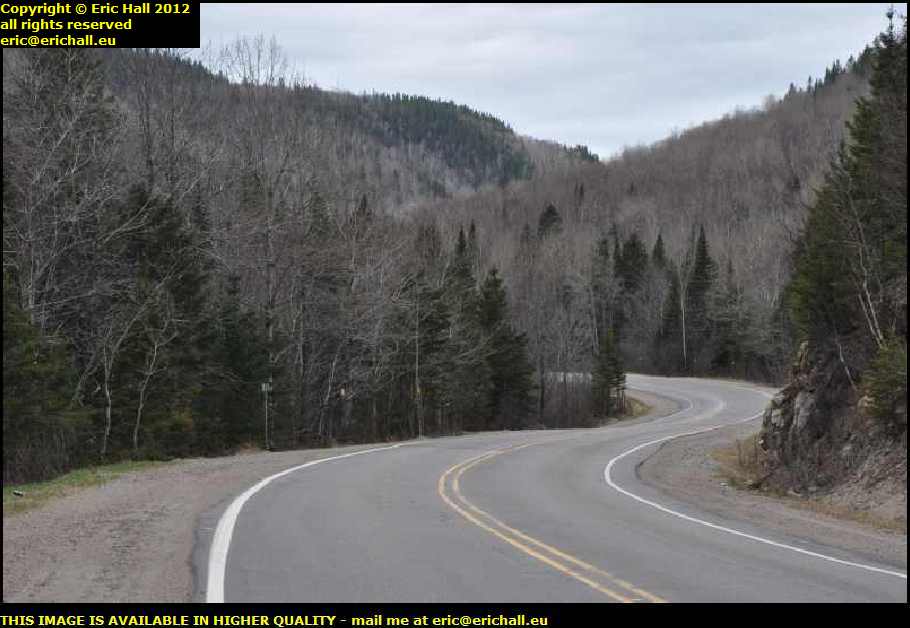
And its shortly after this that we enter another canyon or pass or whatever you want to call it, following the riviere St Jean so we stop the Dodge and leave the car to take another photograph, seeing as there's a suitable place just off the highway.
And if I had known how events were going to subesequently unfold, I wouldn't have stopped here at all. But hindsight is a marvellous thing, isn't it?
For here, we are having a disaster.
Yes, I come to move away after my photo and there's an inordinate difficulty about making the car roll. That can only mean one thing - I have a puncture. Damn and blast! And it's a real puncture too, not just a flat tyre. It must have gone down really quickly
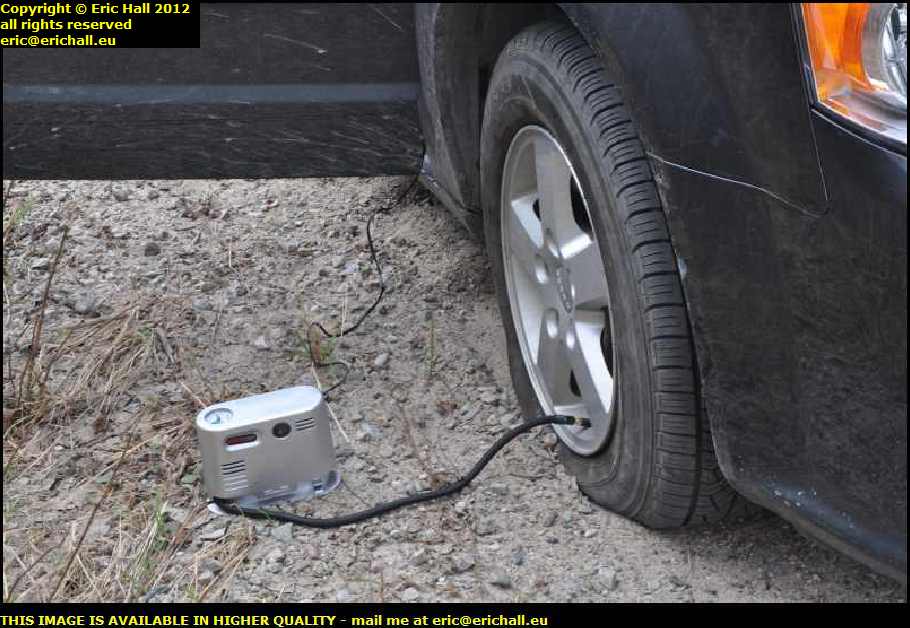
I have a little portable air compressor for moments like these but it's making no headway at all, not even after half an hour. To make matters worse, there's no mobile phone signal either so I can't call up the hire company to seek assistance.
Of course, no-one stops to see what might be the problem (but then again you don't expect that in the modern western world)
Only solution is to change the wheel. I find the tools such as the jack and the wheelbrace, but now I'm badgered if I can find the spare wheel for the vehicle. It's nowhere to be seen.
Eventually, a gendarmette pulls up alongside. Using her radio, she enquires of a colleague where the spare wheel might be. It's in a pan underneath the centre of the car and to wind it down, you have to dismantle the centre console of the vehicle between the seats (and that's not a five-minute job either).
She also tells me that in a small village down the road there's a mechanic who changes tyres and he has a collection of second-hand ones for sale. That's the place to go when I've sorted myself out, then.
Jacking up the car is however a nightmare. It's one of these silly jacks that just sinks into the dirt rather than lifting up the vehicle. Eventually, a couple of laths off my bed are pressed into service and at the third attempt I finally have the car high enough to take off the wheel and rescue the spare from underneath the car.
It's one of these space-saver wheels and so I can't go very far (or very fast) on one of those so we'll go down the road to l'Anse St Jean to see what this mechanic guy has to offer. If he has nothing suitable, I'll have to retrace my steps to Chicoutimi.
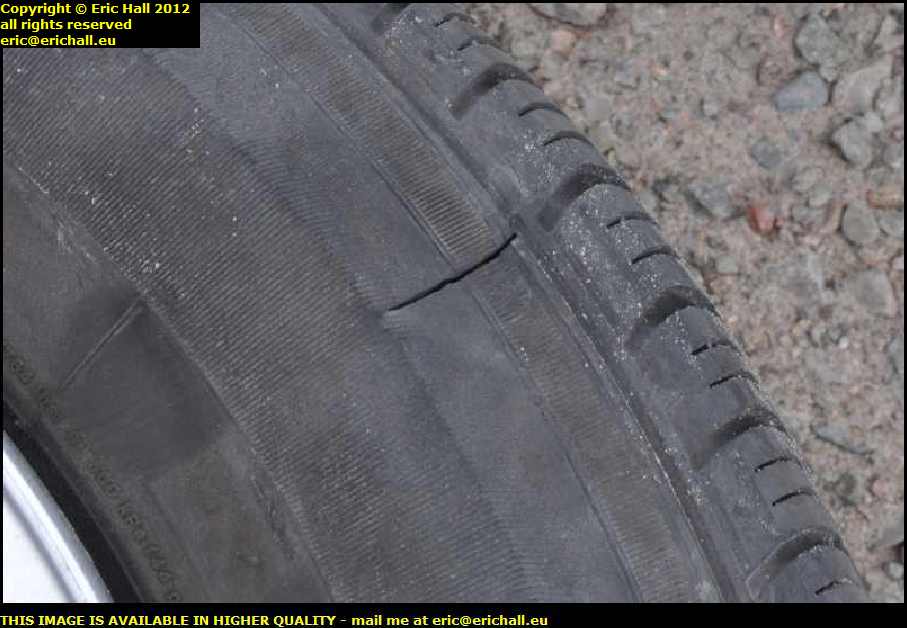
Here's the problem. There's a split of about 2 inches down the sidewall. No wonder the little air compressor made no impression on it. I wonder what caused the tyre to split, though. Usually something like that is caused by hitting something hard, but I certainly haven't hit anything that I know of.
To add insult to injury, I'm now all dirty and covered in dust. A really good wash and a change of clothes is called for tonight.
And at least I know that the little air compressor works, even if on this occasion it couldn't help me out.
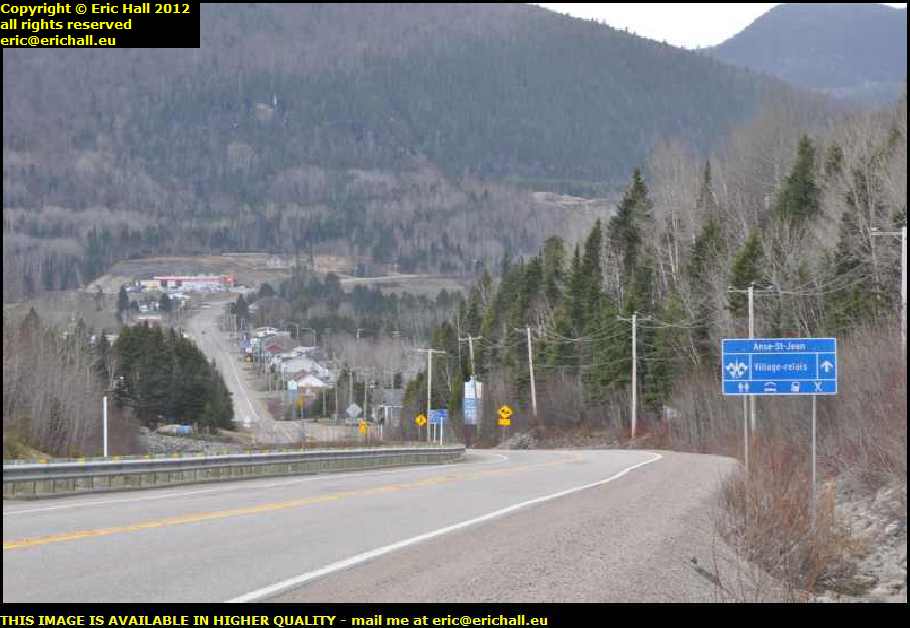
From here, now that I have four wheels on my wagon again, I'll be travelling on towards l'Anse St Jean, which is down the road on the way back towards St Simeon, and hope that I can arrive there before everyone closes.
I track down this mechanic guy and not only is he still open, he does have a second hand tyre that will fit the Dodge. It's not exactly the same size but it's within the legal tolerances, so he tells me (and he's the expert of course), and his bill in grand total comes to all of $45, so I'm not going to complain at all about that.
He reckons that the pneu had probably received a choc. I replied that back in Montreal when the tyre saw Strawberry Moose and me arriving to take the car out, that would have been enough of a choc for anyone.
He also told me that the significance of the letter F in the numberplate of the Dodge is that the vehicle is either a hire car or a company car.
There were also studded tyres hanging around the garage. Apparently it's legal to use them over here in certain conditions.
So we are now back on the road, having lost a great deal of time and also some money. But on that score, it could have been much, much worse. And I also learnt quite a lot, for which I'm always grateful.
And if you think that the Lady Who Lives In The Sat-Nav with her 9 hours and 26 minutes to travel the 120-odd kilometres from La Baie to St Simeon was using her remarkable powers of foresight and prognostication to take into account the delay of almost four hours for changing the tyre, the time to St Siméon is now reduced to a mere 8 hours and 35 minutes.
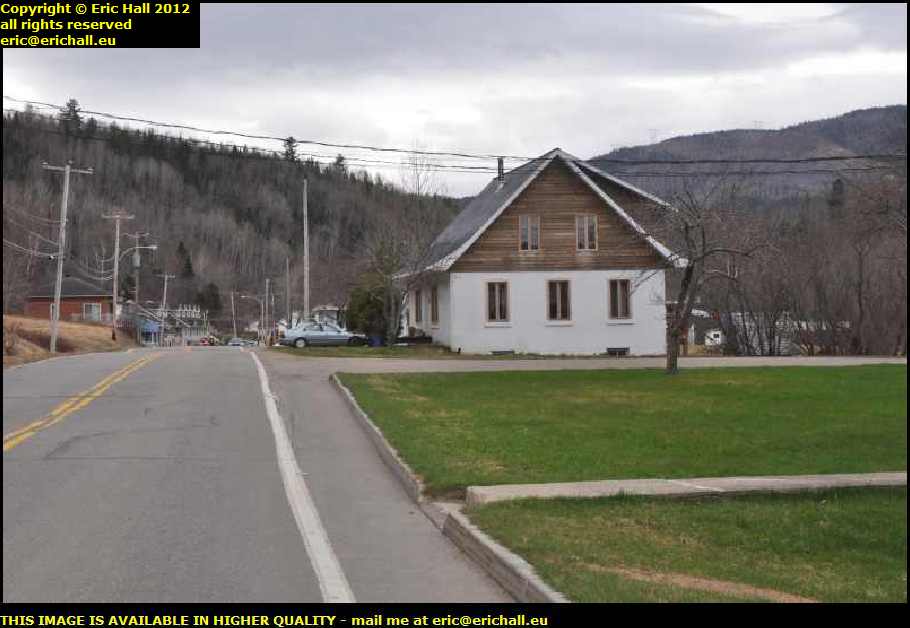
L'Anse St Jean is off the main highway on a road that leads down towards the Saguenay Fjord. From what I've seen of it so far on my drive around to find this mechanic, I reckon that it's well-worth a further exploration despite the lateness of the hour, especially seeing as I'm here.
It was originally the site of a religious mission to the First-Nation Canadians but became settled by European Canadians in 1838 (or 1828 according to some sources) and has a population of about 1200 people.
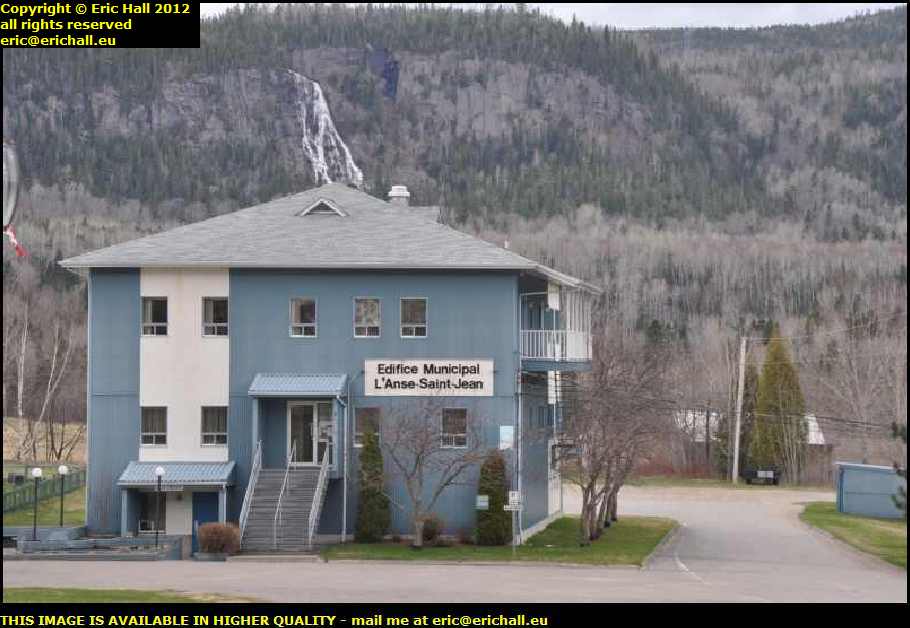
Just look way over there in the background at the spectacular waterfall cascading down the mountain behind the edifice municipale. That's probably the most spectacular waterfall that I've seen foe ages and it's a shame that there isn't a convenient way up to it.
As for the edifice municipale, that was formerly convent and was built par corvée in 1948. The word corvée has many different meanings in the Franciais de Paris, such as "fatigue", "obligation" and "chore", and none of the meanings are ever used in a complimentary sense, and so I wonder what is the significance of the use of the word here.
The convent closed down in 1968 and was acquired by the town in 1974, when presumably it was re-cladded. That cladding on the building looks fairly recent to me.
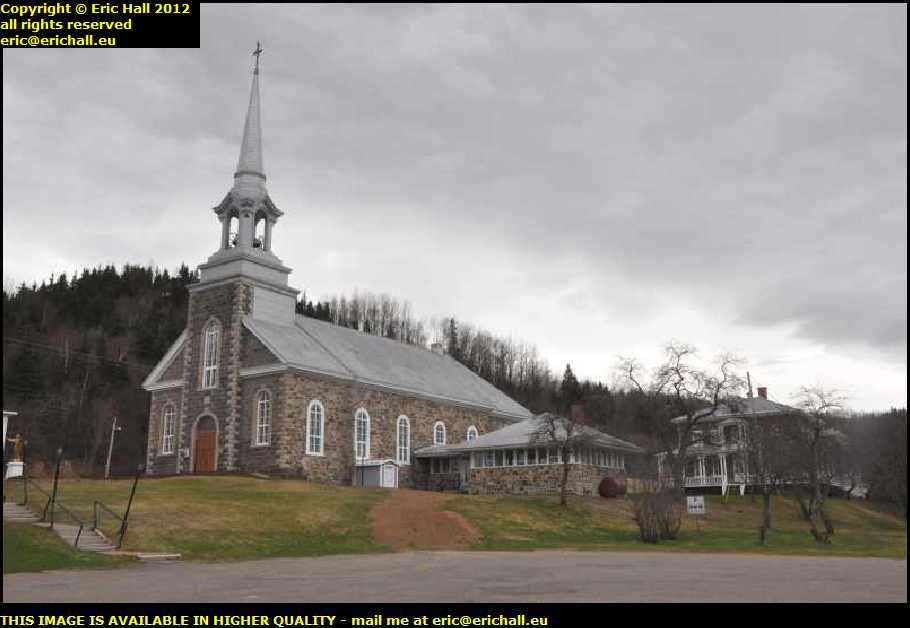
The church and the presbytery to the right, designed in the North American "colonial" style were designed by David Ouellet, whom we have encountered before (I'll have to start keeping an index of architects as well as an index of locomotives and ships) right at the very end of the 19th Century.
Regular readers of this rubbish will know that I have at times been particularly scathing... "you, Eric? Perish the thought!" - ed ... of much of the religious architecture that I have seen in North America. I have to say however that the church here is probably one of the most beautiful that I have seen on my travels in North America.
The town can quite rightly be proud of this, and David Ouellet can take a bow.
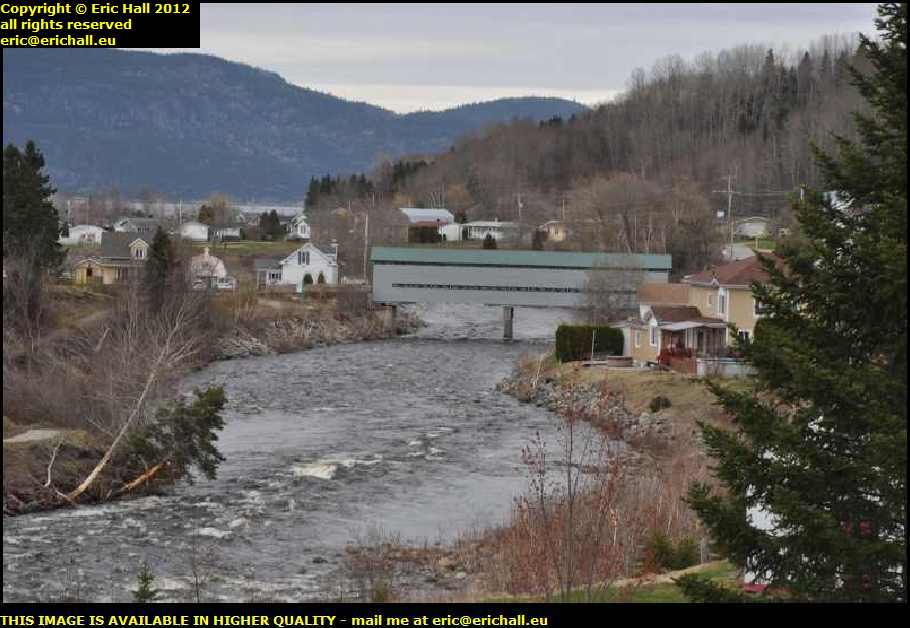
If the church isn't enough to satiate your appetite for l'Anse St Jean, we have a covered bridge here too. It was designed by Auguste Baudet in the town élaboré style and built in 1929.
It's the only one remaining of four covered bridges along here and we are luck to still have this one, for it was swept away in a massive ice-melt in the Spring of 1986. It didn't go far though, and was back into place in the December following.
To celebrate its successful rehabilitation, Strawberry Moose and I went for a ceremonial crossing in the Dodge.
I've not been able to discover the fate of the other three covered bridges. Were they also swept away with the Spring melt-water, or did they suffer the usual fate of a wooden Quebecois structure and succumb to a conflagration? I think we should be told.
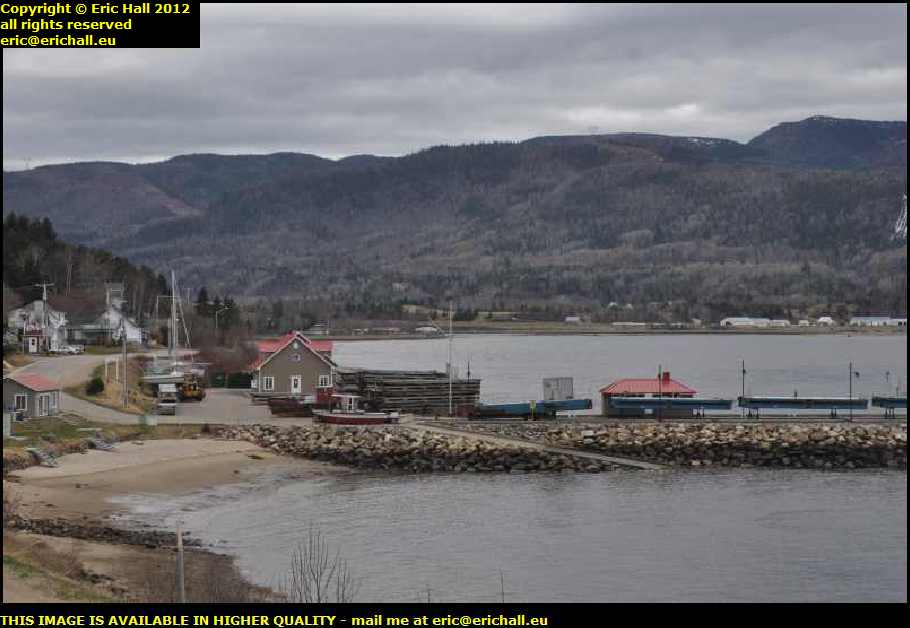
My little perambulation brings me to the shore of the Saguenay Fjord and as you might expect, there's a little harbour here. You need to bear in mind that the road network in places like this is a comparatively recent phenomenon and even until comparatively recently (and in fact, in some places, even today as we shall find out if things go according to plan) the only connection with the outside world was by water.
Not only that, the water here was the means of livelihood of many of the inhabitants. In a little isolated village such as this, fishing would have been one of the main commercial activities.
Today of course, the harbour plays another commercial role, being a haven for pleasure boaters who travel up and down the fjord.
The presence of the harbour here in the past would have also been responsible for other economic development. With all of the timber here in the vicinity, it's no surprise to learn that there was formerly a thriving timber industry here - at least a sawmill and a carpenter's workshop.
The water of the river may well have provided the power for the machinery and the water of the fjord would have been the means by which the output would have been taken away.
With the presence of an isolated population here, there were several other domestic industries here too. The presence of a blacksmith and a cobbler has been recorded and there was also a flour mill.
The flour mill is not such of a surprise. You will have noted that we are in a deep, wide valley here. The mountain all around would protect the valley from the worst extremes of the weather. In fact, the valley is noted for its "mild climate" - not that I would call it mild but I suppose that anyone living anywhere else in Quebec would
With the soil in the valley looking much more fertile here than in many other places nearby, probably due to the amount of silt that is brought down by the spring melt and so with the "mild climate" it would be quite possible to grow a crop of wheat.
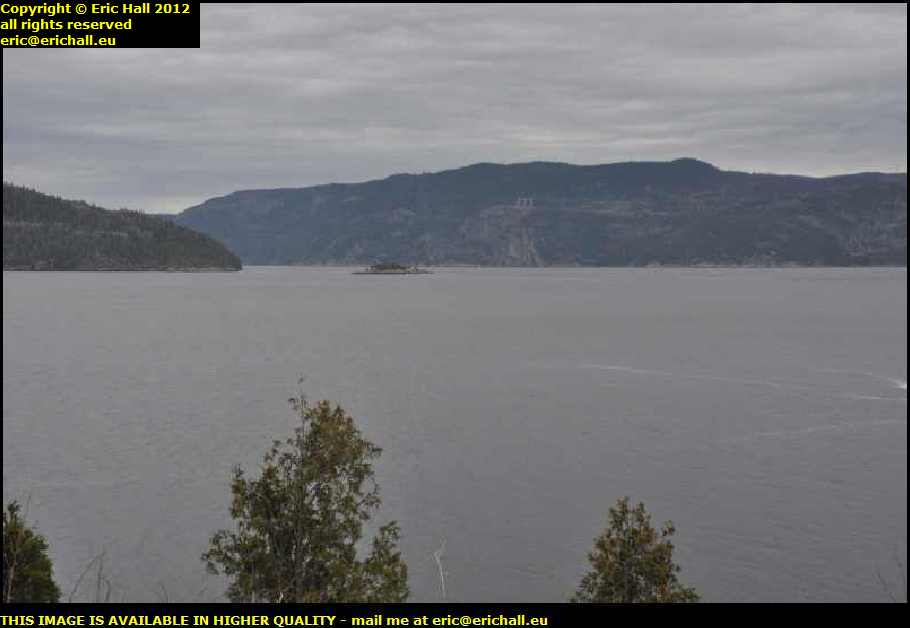
There's a vantage point near the harbour where there's a splendid view of the Saguenay Fjord and where you can take a quite spectacular photograph, I imagine, when it's not teeming down with rain because this past half-hour the heavens have well-and-truly opened. It's a good job that I had my puncture when I did.
Nevertheless, despite the rain, I have decided that l'Anse St Jean is beautiful enough to be added to my list of the most beautiful places in the world, and if I'm so impressed with it while we're having a torrential downpour, imagine what it muct be like in the sun.
In fact, you don't have to imagine it.
People with long memories, especially those from Europe, might recall that many years ago, Michelin, the French tyre company, produced a book all about Quebec - a potted history of the Province and a brief description of places to go and things to see.
If you are ever lucky enough to track down a copy, you will find that the highlight of the book is a glorious, two-page-spread colour photograph of l'Anse-St-Jean in the sunshine.
Clearly Michelin thinks that, despite all the other magnificent places in the Province, l'Anse-St-Jean is the most beautiful place in Quebec and I'm not going to argue with that.
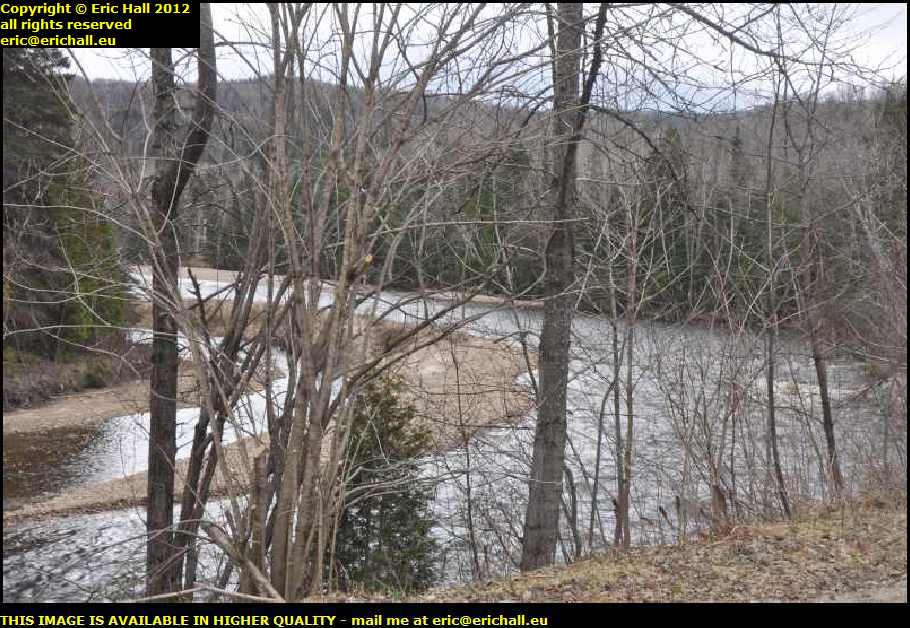
There's a back way out of the town. A dirt road that follows the river and so I decide to go out that way - not the least of the reasons being that I spend a great deal of my time on dirt roads and so I can bed in the tyre right now while I'm still within hailing distance of the tyre place.
There's a good place to stop, right on a meander of the river, and you can see all of the sand and gravel that the river has deposited as the meander has caused the flow of water to slow down.
Back on Highway 170 again, I continue south-eastwards towards St Simeon, thinking to myself that I'll be lucky to arrive at the overnight spec that I have in the back of my mind before dark.
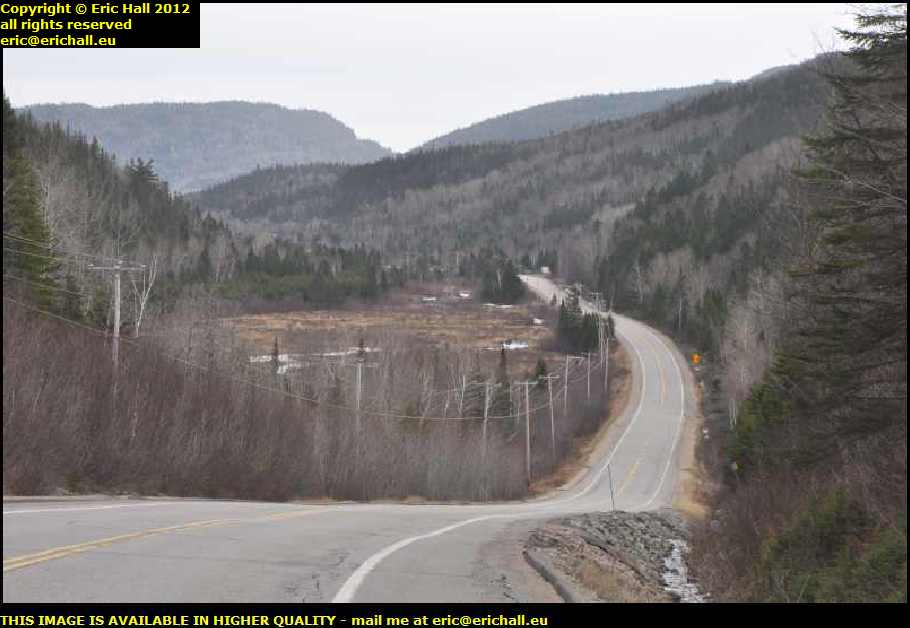
I am however not unduly worried because as long as there is light, there is still some magnificent scenery to see.
The valley of the riviere du Cabonage is every bit as spectacular as the valley of the riviere Sainte Marguerite that brought me out to the Saguenay and lac St Jean several days ago and even though I'm approaching the end of my journey around here, I'm still being impressed with what I'm seeing.
It's not finished yet either. At the small town of Petit-Saguenay there's a road signposted down to a harbour, the quai de Petit Saguenay, on the Saguenay Fjord and so in the twilight I go for a look down there as well.
Who knows what I might find down there?
©