 | LONDON |
COVENT GARDEN
Covent Garden is claimed to be a corruption of "Convent Garden". It was originally a 40-acre plot of land that was the kitchen garden of the Convent of St. Peter at Westminster and supplied all the fruit and vegetables for the monks. It later became an important source of food for the city. Prior to that though, there had evidently been some kind of settlement as Saxon remains have been uncovered.
It was expropriated by the Crown following the dissolution of the monasteries and passed through several hands before becoming vested in the Earl of Bedford in the early 17th Century. It was then developed as a private square built to the design of Inigo Jones during the early part of the reign of Charles I.
Jones was a self-taught architect who came from no kind of background at all, yet rose to be Surveyor-General under the reign of James I. He is said to have visited Italy twice, on one occasion being the guest of the Medici family at their court in Florence. He was evidently influenced by what he saw, and it was his Italianate styling with buildings such as the Queen's House at Greenwich that drew him to the attention of the Earl of Bedford.
Bedford had plans for a square that would resemble an Italian piazza, and this was right up Jones's street.
The Underground station at Covent Garden is a weird place in itself. The only way out is up being squashed like sardines in a couple of lifts, unless you fancy negotiating the 193 narrow spiral stairs. I wouldn't fancy this station in the rush hour. I'd be tempted to carry on to Leicester Square and alight in comparative peace and quiet - it's only 300 yards away.
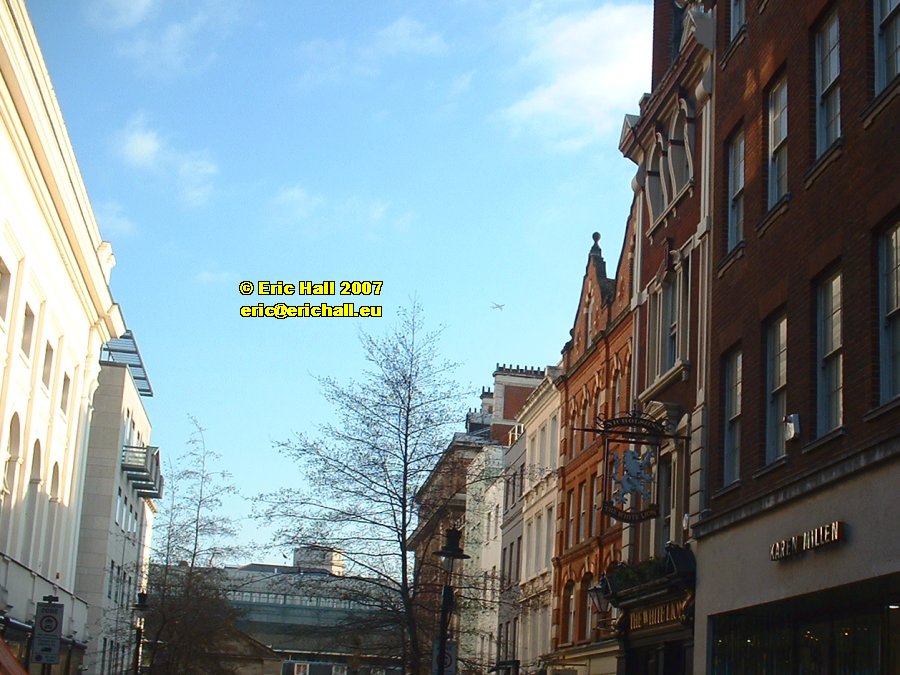
I stepped out of the station into James Street and was winding up the Fuji just as this aeroplane was doing a circuit overhead. It seemed too good an opportunity to miss.
You can also see from the roof line that there isn't very much at all original on the left. It seems mostly to be bland neo-modern architecture. What the Lutwaffe didn't account for, the planners did for the rest.
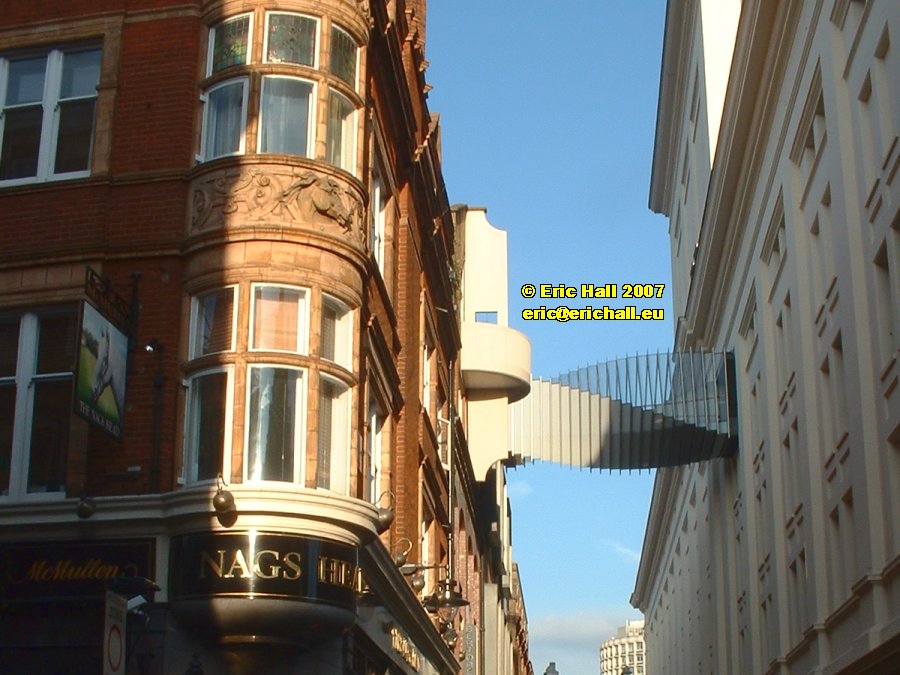
And it was just as well I had my camera in my hand a hundred yards or so further on. I was just strolling past Floral Street and I happened to glance down the street. It's probably the weirdest footway I've ever seen.
It must be a really uncomfortable way to cross the street, so I'm trying to work out how the optical illusion works. There has to be one, because I can't think of any other reason that this passageway would be shaped the way it is.
As I said above, the market has been an important part of London life for 800 years one way or another. Its importance increased following the Great Fire of London in 1666 as it was one of the very few markets to escape the conflagration.
What with all of this, once the square was opened up to the public, it had quite the opposite effect than that intended. It attracted all sorts of public here and became such a busy thoroughfare that the rich deserted it to places like Bloomsbury and then to Mayfair.
What happened next of course was that the area went downhill fast, so much so that Sir John Fielding
It wasn't until 1813 that market trade in the area became regulated, but even so, it wasn't until a major cholera outbreak in 1850 that drastic action was taken, and a major programme of clearance and renovation of the area began.
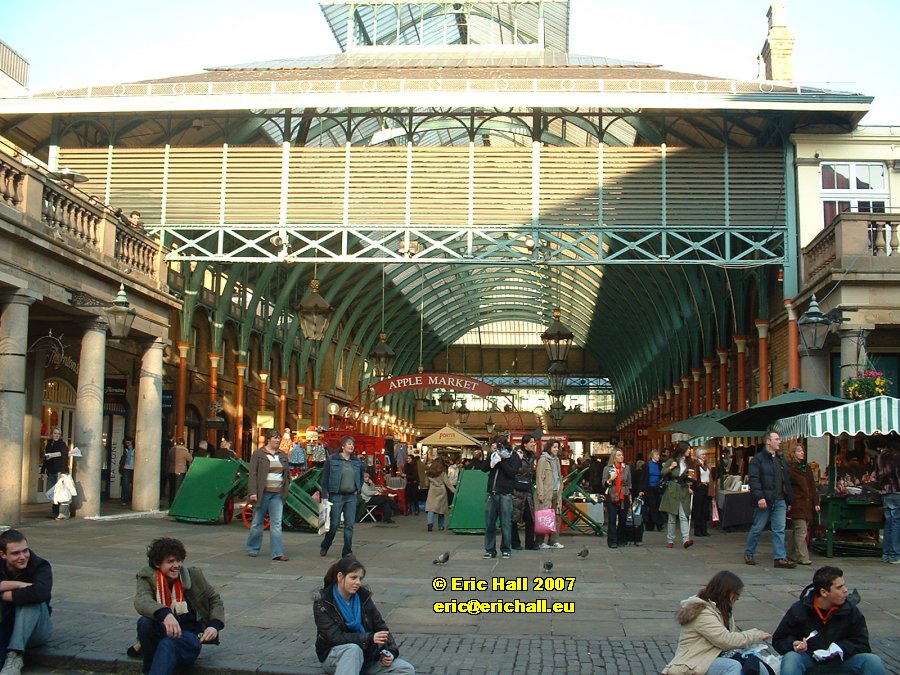
There wasn't always a market hall here of course. The present building was designed by Charles Fowler, well-known for his public buildings, churches and markets, and dates from 1831.
The square is also said to be the site of the first "Punch and Judy" show, recorded by Samuel Pepys
And while we're on the subject of the performing arts, the Alfred Hitchcock film Frenzy
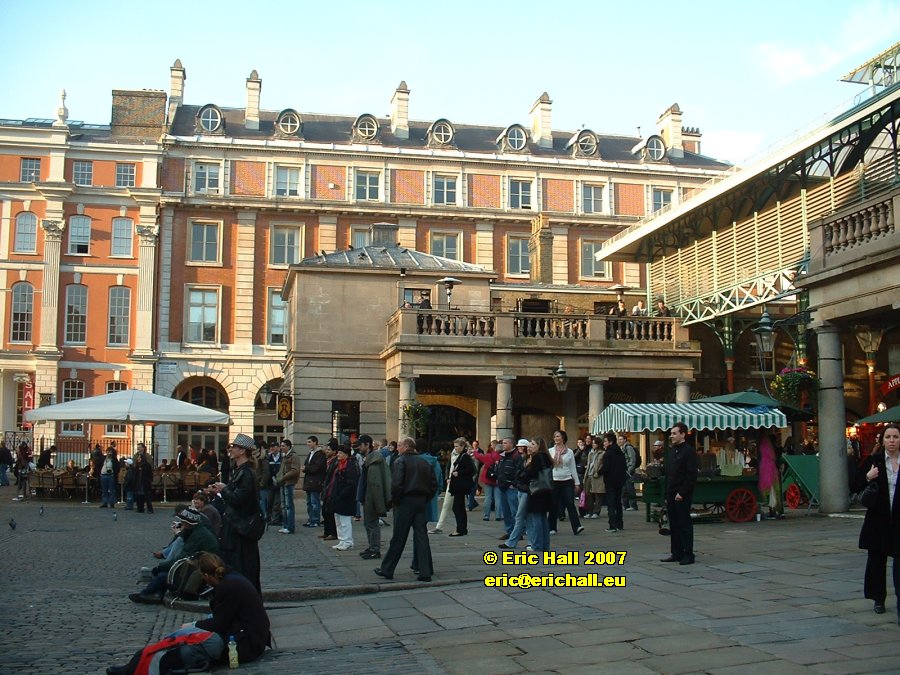
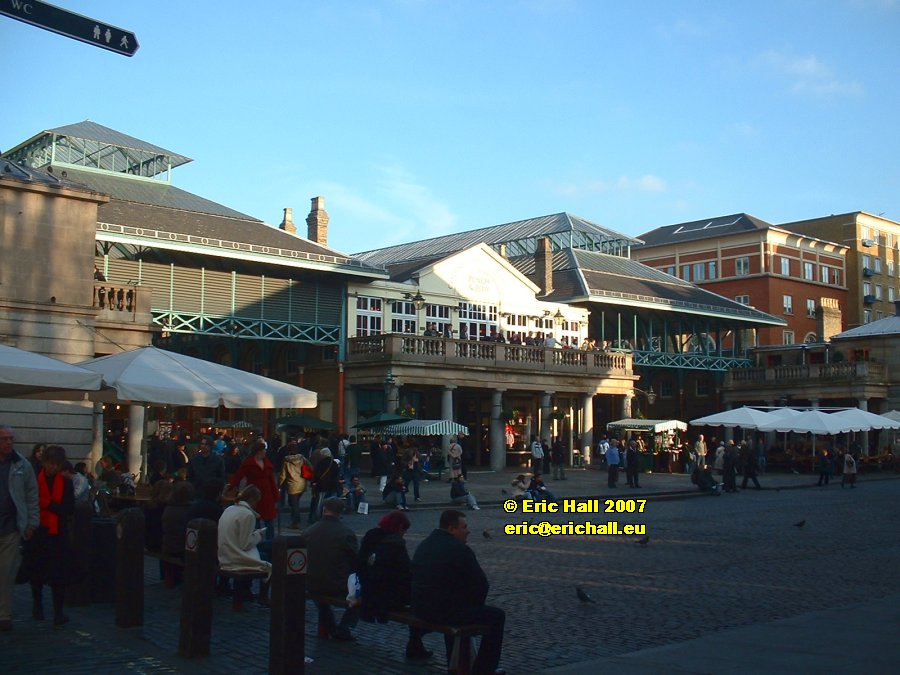
This view is of the north side of the square. Most of what Jones built here, as well as his work on the east side of the square has now been demolished.
On the southern side was the boundary of the home of the Earl of Bedford so nothing was constructed here. On the west side (to the left of the photograph) is the Church of St. Paul.
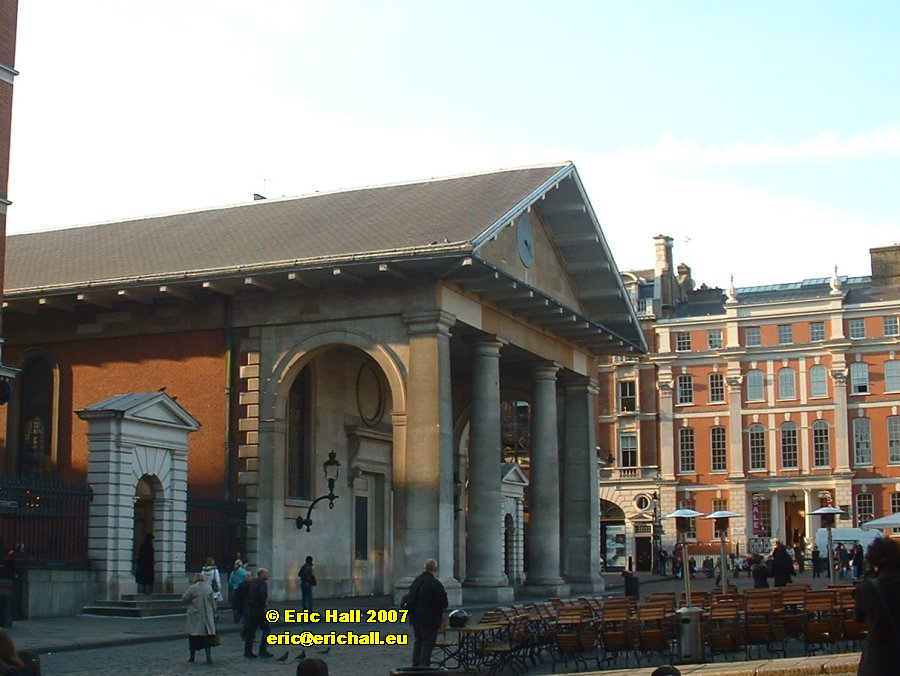
This is St. Paul's church. Not Sir Christopher Wren's masterpiece, but that of Inigo Jones. The Earl of Bedford thought that he should provide a church for his square, but costs of construction were such that economies were necessary. He is said to have told Jones not to be extravagent, and that a barn would do. Jones is said to have replied that "your lordship will have the finest barn in Europe"
Construction started in 1631 and was completed in 1633, at a cost of £4000. It was opened for worship in 1638. Unfortunately there isn't much left of the original church. It has been remodelled on several occasions, including once after a devastating fire in 1795.
While we're on the subject of fires, Londoners don't realise just what a lucky escape they had. Once Jones finished the church here, he was asked over to the other, more famous St Paul's with a view to commencing a restoration project there. Unfotunately the Civil War prevented him from making a start (say what you like about the Roundheads and Cavaliers, at least they had good taste). Then in 1666 the cathedral burnt down - which led to the building of Sir Christopher Wren's masterpiece. By all accounts, an extremely lucky escape.
This St. Paul's though has several claims to fame, the chief of which is that the first victim of the Great Plague of 1665 was buried here. For those of you who know your Shaw
It's also the setting for the very famous poem, which dates back to the days of Sir John Fielding
As I was walking by St. Paul's
a harlot grabbed me by the ****s
I cried for help, but no-one came
And so she grabbed my ****s again.
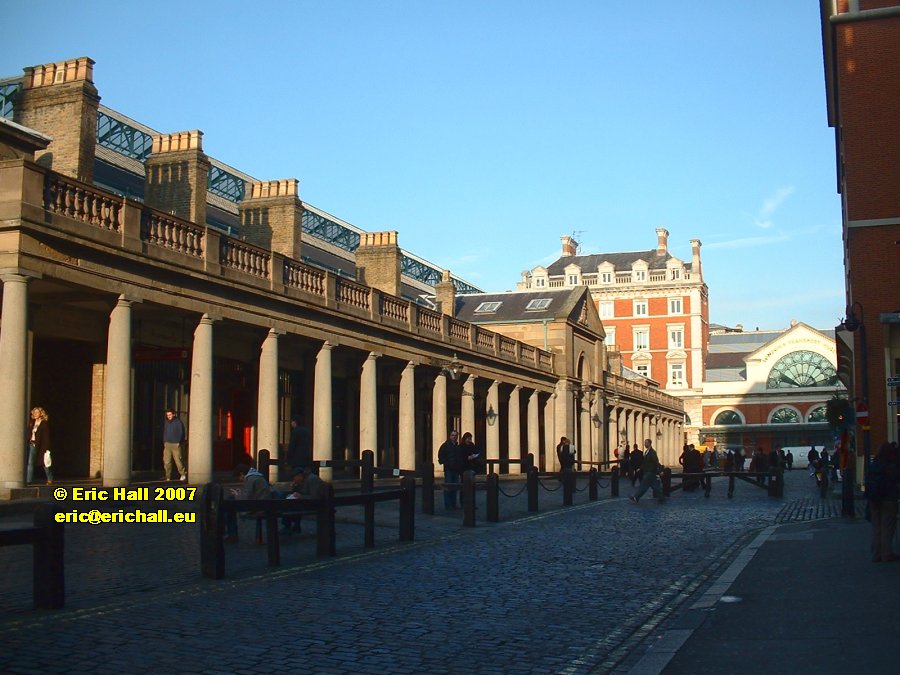
When it was built in 1831, the Market Hall was said to resemble the old Roman baths at Bath. I was at the old Roman Baths a short while earlier and took a couple of photos. If you were to compare them, you'd have to look very long and hard to see any resemblance.
Don't be misled though by the differences in stone used in the construction of the Roman baths and that used in the construction of the Covent Garden Market Hall. Until the days of mass transport in the late Victorian age, builders were pretty much limited in the choice of building material to that which was close at hand.
This can be graphically illustrated in north-west England. In the Peak District you may see some peasant cottages build out of local limestone, yet within a day's walk from there on the Cheshire Plain, the Lords and Ladies were living in timber-framed houses plastered with mud and straw. This is an extreme example, but it makes the point.
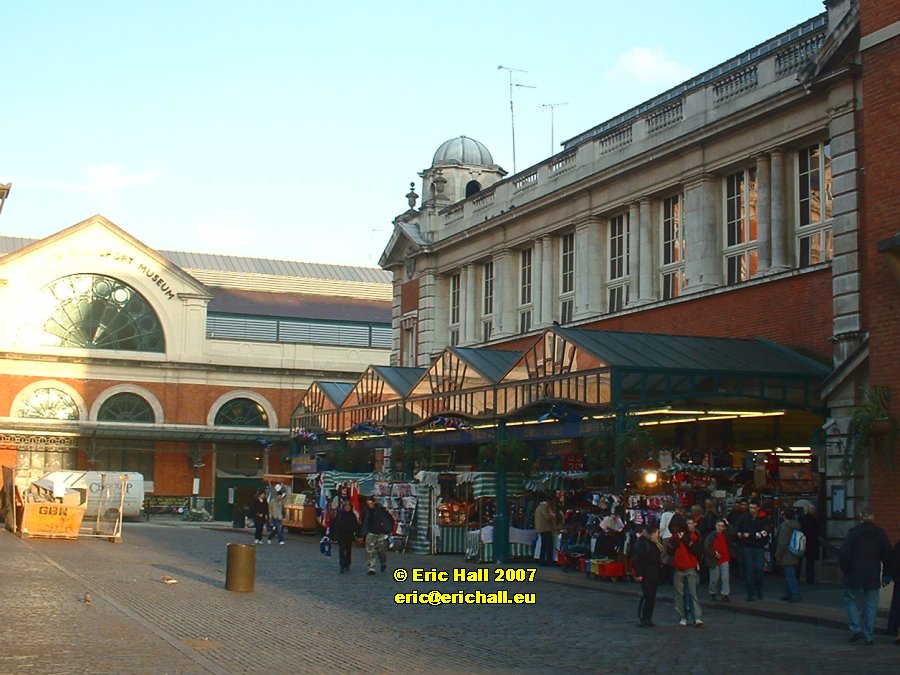
If you look at this photo of the south face, then there's even less of a resemblance to the Roman Baths.
The building that you can see at the rear in this photograph and the one above houses the London Transport Museum and the National Theatre Museum. It was built in 1872 to be the first part of the Flower Market. Once the market closed, it underwent considerable refurbishment, as you can gather from the condition of the building, and was reopened finally in 1993.
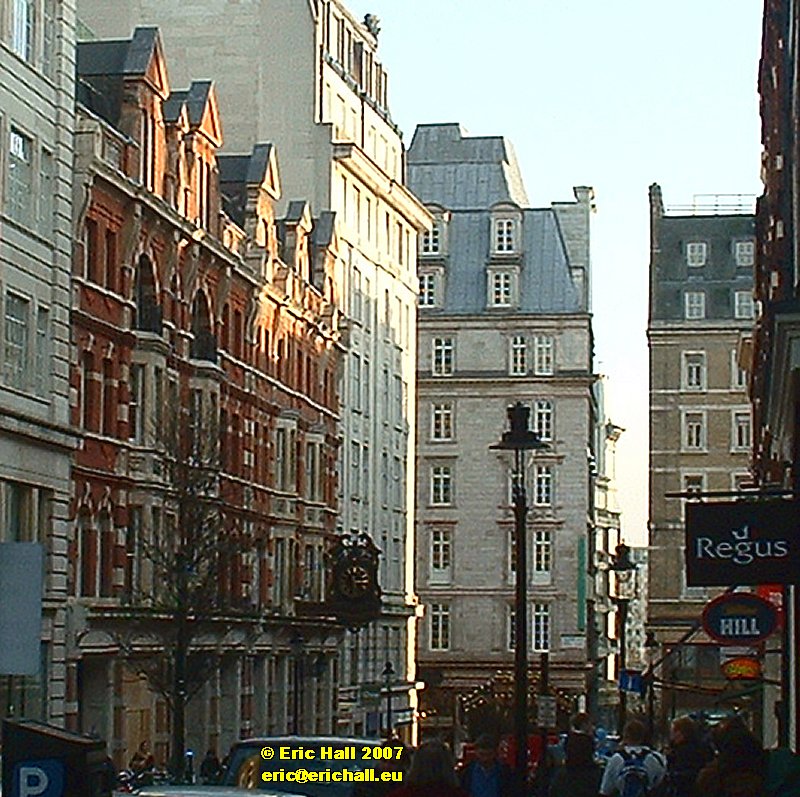
On the southern side of the square, nothing was built as it was effectively the rear of Bedford House. There was a wall here against which many stallholders would exhibit their wares. The house was demolished in 1705/6 and the wall was taken down, a decision that was not very popular with many of the stallholders, who suddenly found themselves pitched unceremoniously into the middle of the square.
Following the demolition of Bedford House, the southern side was developed. This included a street, Southampton Street, that ran down to the Strand and eventually the Thames. Famous residents of Southampton Street include the actor David Garrick and Vincent van Gogh. W.S. Gilbert, he of "Gilbert and Sullivan" fame, was born here.
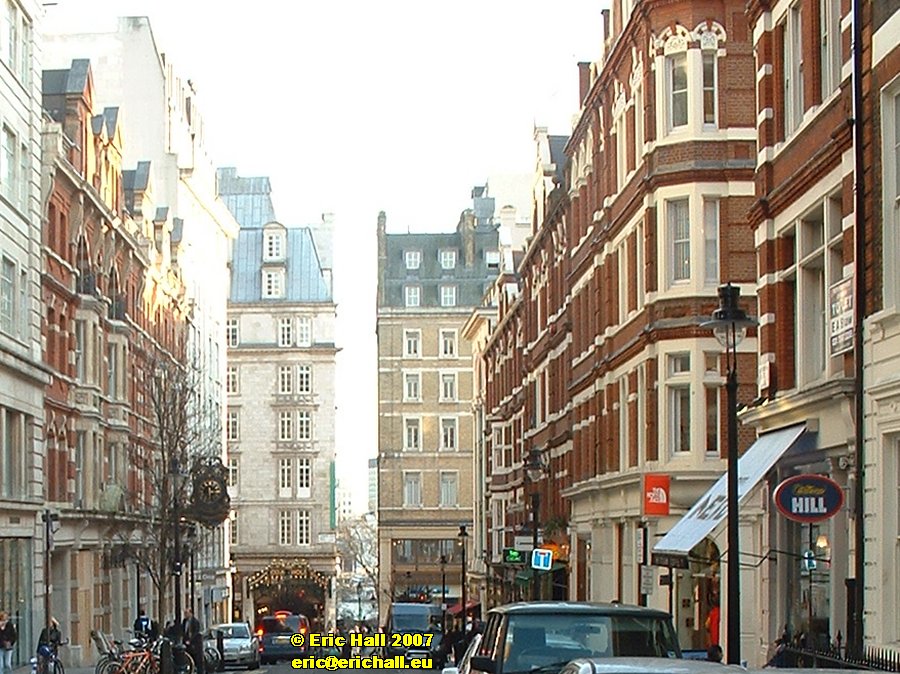
Halfway down Southampton Street was a gate with porter, whose duty it was to prevent the passage of carts to the market by this street. The gatekeeper's lodge was actually in the middle of the street. Public pressure eventually caused the restrictions to be removed. The porter's lodge was demolished round about 1861, and the gate was removed in 1872.
As the British empire expanded, more and more exotic goods became available, and were frequently sold at Covent Garden. It is more than likely that once the restrictions on carts were lifted, these goods came up this way to market from the Thames, which you can see in the distance in the centre of this photograph.
You only have to look at some of the photographs above to see how narrow and tortuous the streets are here. With the rapid rise of road transport after the First World War, one can easily imagine the chaos that was caused by heavy goods lorries bringing in flowers, fruit and vegetable produce from all over the UK.
There was a proposal to move the market to a site in Bloomsbury as far back as 1926 but that was resisted. Nevertheless, the situation was never going to improve. In the late 60s there were proposals to demolish the entire area and redevelop it completely. It goes without saying that there was an enormous public outcry.
Many years later, a gawky 15 year old Naomi Campbell was "discovered" by a talent scout walking through the square. I wonder what the public would have said about the redevelopment plans had they known about this then (said he, quickly ducking underneath a flying mobile phone)?.
Back in 1973, in order to forestall the developers, the government gave "listed building" status to 250 of the most important buildings in the square, thus preventing its redevelopment.
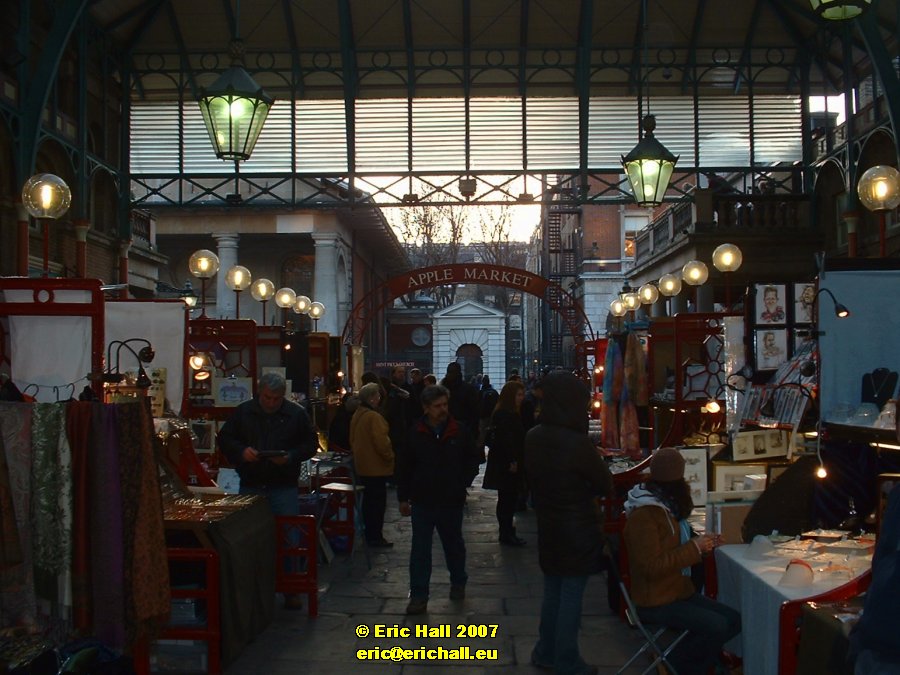
It was during this period that the market traders came to agree that relocation was essential, and in 1974 they moved acros the river to the site of the old London and South Western Railway wagon and carriage works at Nine Elms.
The square slowly sank into decay for several years until the old market building was redeveloped and refurbished. It's now home to craft and souvenir stalls and general tourist tat.

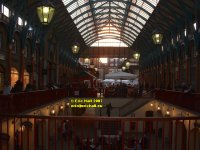
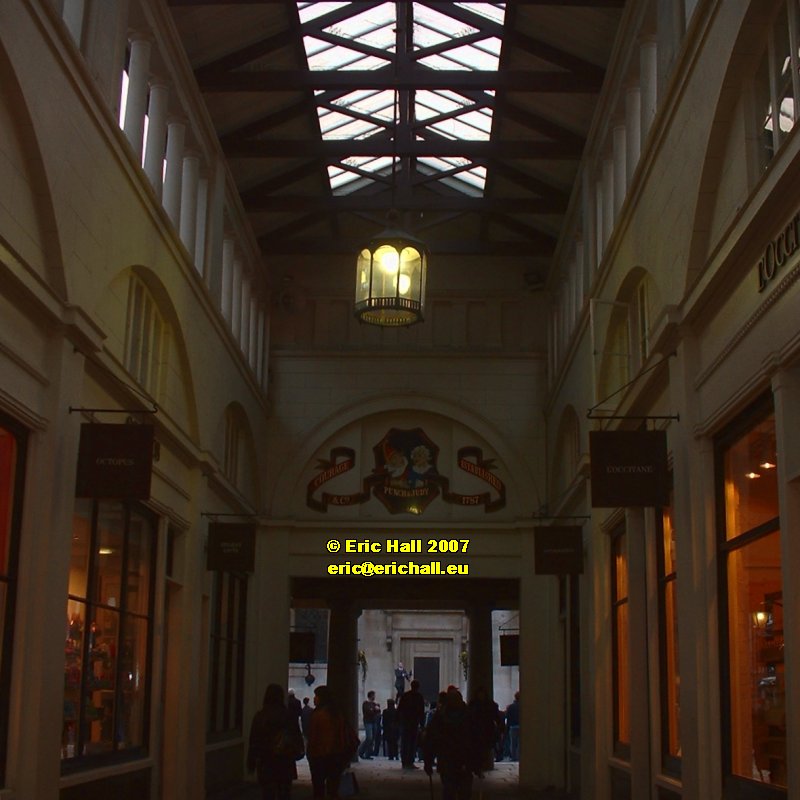
It was following the renovation of the market hall that the basement was opened up to the public. And you have to admit that they have done a marvellous job of the renovation here. This is undoubtedly my favourite part of the whole scheme. There are a number of shops, and cafes too where it's quite possible to have a quite chat away from the hustle and bustle of the tourists upstairs.
And not to mention the hustle and bustle outside too.
Legitimate street performers in London have to be licensed, a situation that exists in many other cities of the world. And while I was taking some of the photos outside the market hall, one of that ilk thought it quite funny to harass me by standing in front of me to obstruct my field of view every time I went to press the shutter.
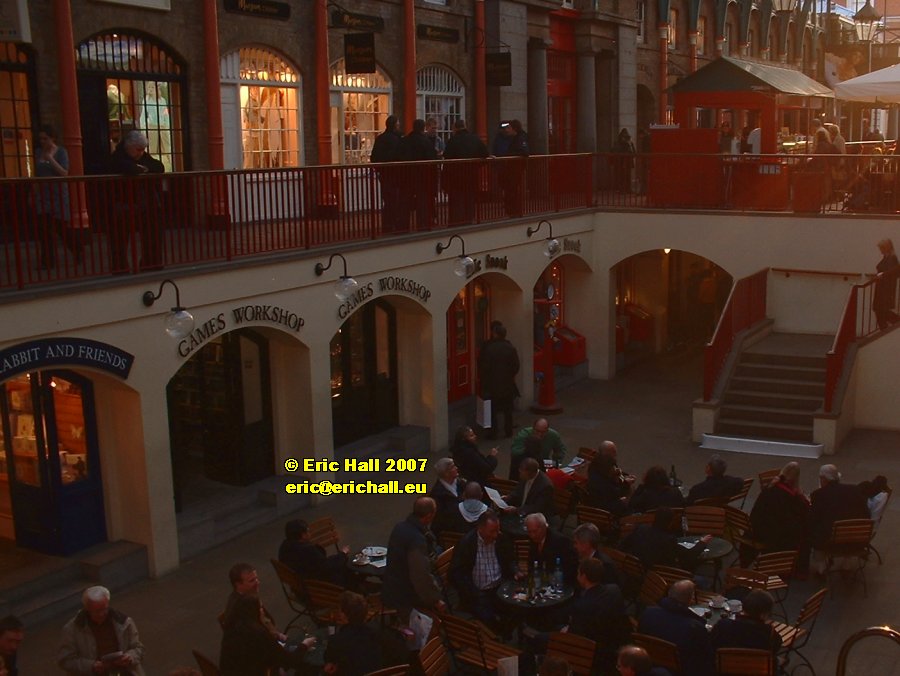
What is probably unique here in Convent Garden is that in order to be licensed to perform, one needs to pass an audition. I whispered quietly into the gentleman's ear that he would probably find it difficult to pass any future audition with two broken legs and a camera stuffed up his left nostril, and he gallantly stood aside.
Well, it wasn't actually his left nostril up which I threatened to lodge my camera, but this is a family web site after all.
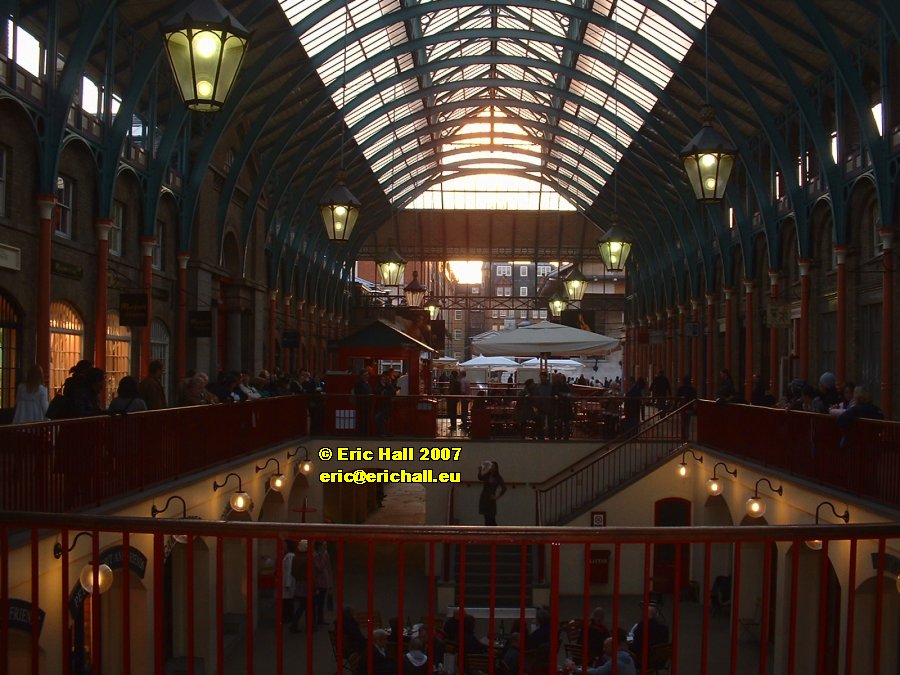
There was a performing artiste inside too, as you can see. This lady was singing well-known operatic arias, and she was pretty good at it. This auditioning thing seems to be paying off in spades.
But although I can clearly recognise the quality, I find it difficult to appreciate the style. I come from a musical background (my grandmother was a Ziegfeld Folly in New York 90 years ago), and as a child I was forced to sit through endless musicals. So as soon as anyone goes into the song when I'm about,
To me, all opera comes under the classification that Gioachino Rossini applied to Wagner's operas
The physicist and discoverer of the ionosphere Sir Edward Appleton reflects my opinions of opera precisely - "I do not mind what language an opera is sung in so long as it is a language I don't understand"
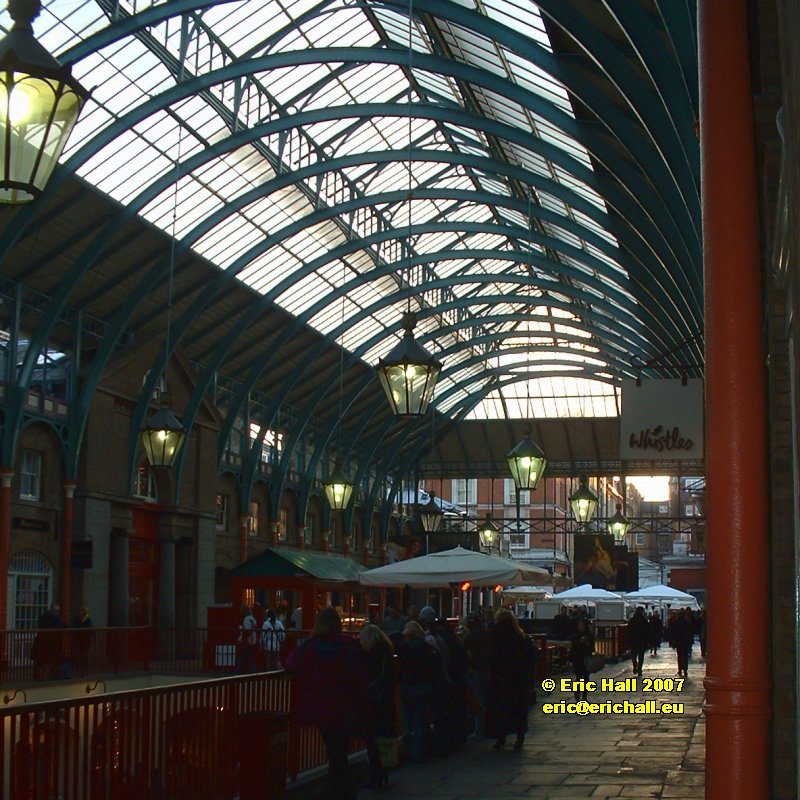
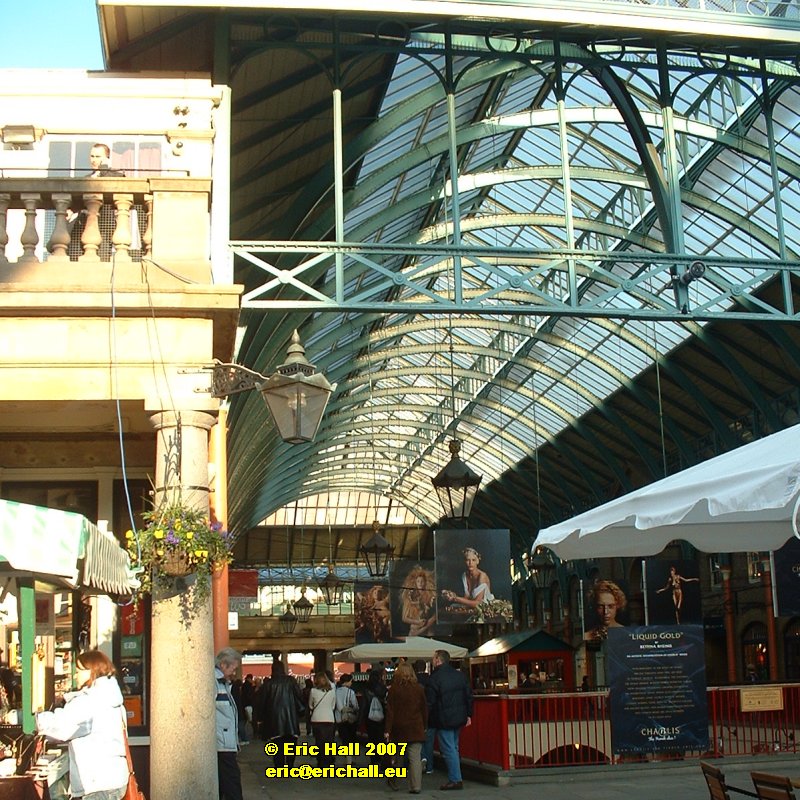
You can tell by just by looking at the roof that the Market Hall is pre-Victorian in design. Back in 1831 Fowler had a considerable space to cover and as any fule kno the more you can cover under the same roof with the fewer supporting pillars, then the greater floor space you can have.
Here, the pre-Victorian engineers are experimenting with large open spaces, and have gone into two spans to cover the market area. It wasn't until 1875 that the one of the bays was roofed. The other had to wait until 1889. Contrast this with what later Victorian engineers had been able to accomplish, or even the massive 65 metre-wide steel and glass construction of the Kòlner Hauptbahnhof of 1894. How about a building such as these for Covent Garden?
But leaving all of this aside for a moment, while Victorian engineers are famous for Gothic magnificence and massive construction, I'm not sure that you would want to recruit Sir Gilbert Scott for the interior of your peèce de resistance
And as much a big fan as I am of Victorian Gothic (and I nearly attended a school designed by Sir Gilbert Scott), I'm glad they employed someone with finesse to work on the interior of the Market Hall. This is absolutely magnificent, isn't it? I am just so impressed.
I'm really going to have to get cracking on my apartment if I want it to rival this.
©