 | CANADA |
BAIE ST CATHERINE
Having had our little diversion to the Baie des Rochers on the previous page in May 2012, we've now travelled back in time to 2011 and Highway 138 in order to resume our pursuit of those German tourists.
But just a brief word. While I might be saying 2011, I passed here twice in 2010 and also twice in 2012 and so this is really a merged lot of 5 different voyages. Therefore if you come down along this road and think that one of my photos seems to be out of order then it won't be too much of a surprise.
If you want to know in which year a particular photo was taken, simply enlarge the image (by clicking on it) and look in the top left-hand corner.

First object that we encounter in 2012 is the Deuxième Lac du Seminaire - and no, I don't know where the Première Lac du Seminaire might be.
The first thing that you'll notice if you look closely is that it is still completely frozen, even in May. Mind you, I have been colder than this on my travels this year - I'm out of the car and I'm not frozen. And when I passed here a week or so later, there wasn't a trace of ice to be seen.

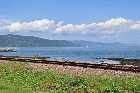
Just rounding a bend in the road, we can see Baie St Catherine in the distance. The river that is in between us is the saguenay and we'll be across there on a ferry in due course.
I say that it's a river, and while it might be called such, it looks to me every bit like a Norwegian Fjord. I'll take you on an excusion up there when I'm up-to-date with my notes and you can see for yourself what I mean.

Highway 138 is undergoing what we call a continuous process of evolution. It looks different each time that I pass this way and you cannot go too far without encountering road works.
Here, we've just had some dynamiting of the banks of the road and if you were with me in Labrador in 2010
you'll know already just how enthusiastic a Canadian dynamiter can be. Now they are shovelling away the rubble, and they may be here for a while.
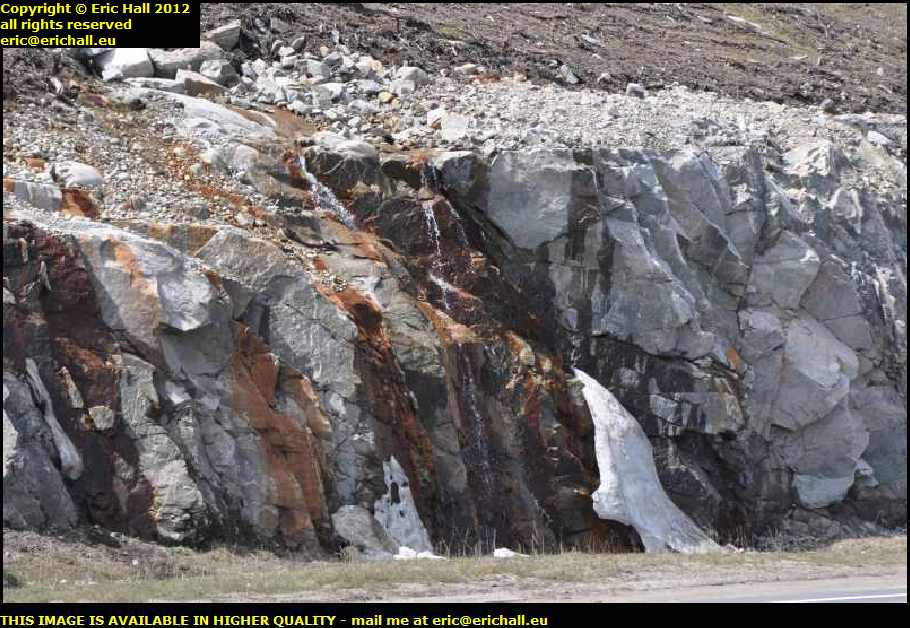
Waiting here while they sort themselves out does give me a chance to admire the view, I suppose. And this is a view that is quite interesting
You may recall from our visit to Labrador in 2010 that the whole of the Canadian Shield is crammed with iron-ore deposits. You can see how much iron-ore there is around here by looking at the iron-oxide stains on the rocks just there where the iron has been flushed out by the water flow.
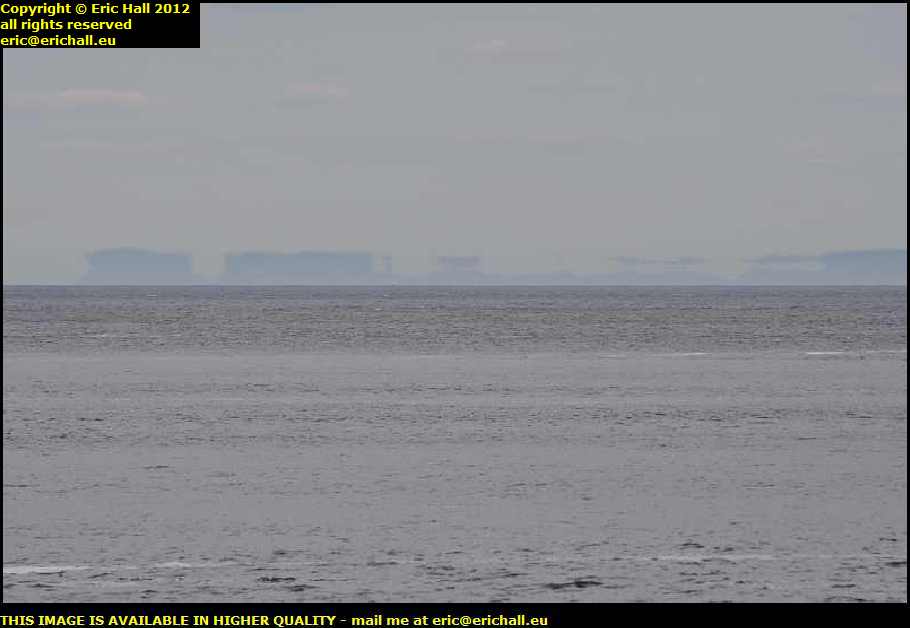
Right across in the distance is the southern shore of the St Lawrence round about where Trois Pistoles is. And if you were to look on the original high-quality image that I took (which you won't see because I don't have the bandwidth to upload it) you'll see so much better the most amazing rock formations on the otjer side.
So amazing in fact that Neil Young would have no difficulty whatsoever in becoming lost in them.
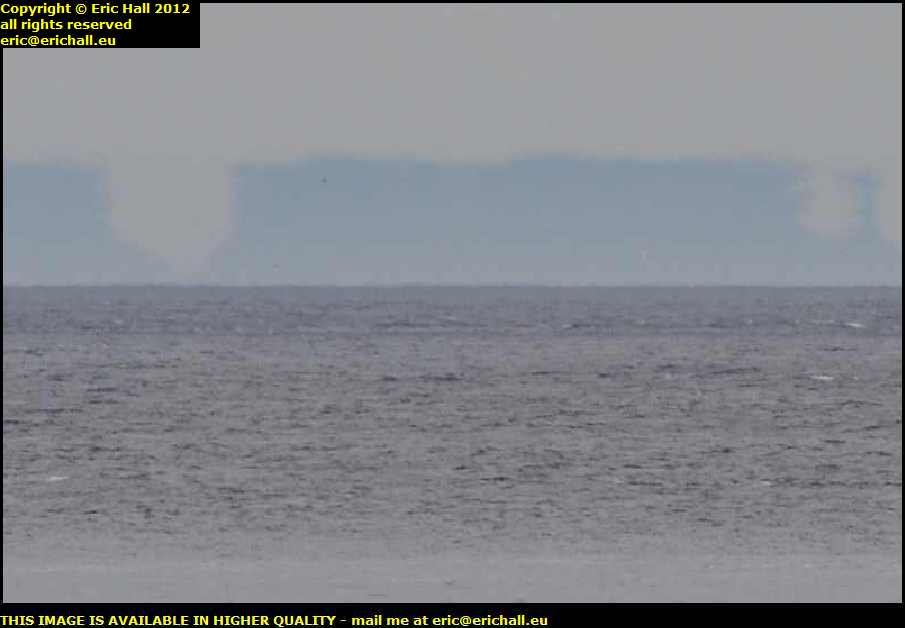
Cropping and enlarging a section from the image (having a decent camera

Even though it's late afternoon, there's a heavy mist on the St Lawrence and that is creating an optical illusion.
It was somewhere over there that the Transatlantic liner Empress of Ireland sank with heavy loss of life following a collision in heavy fog and when you see this sort of thing, you can understand why.

I mentioned sandbanks on the previous page and it was here that I was able to have a better view of that particular one. You can see how shallow the water is here by the way that the wave in the foreground is breaking.
You may remember that I mentioned that I flew over a sandbank in the St Lawrence in 2011 and that it could well have been this one. However, a good way further downstream I found one that was a much-more-likely candidate.
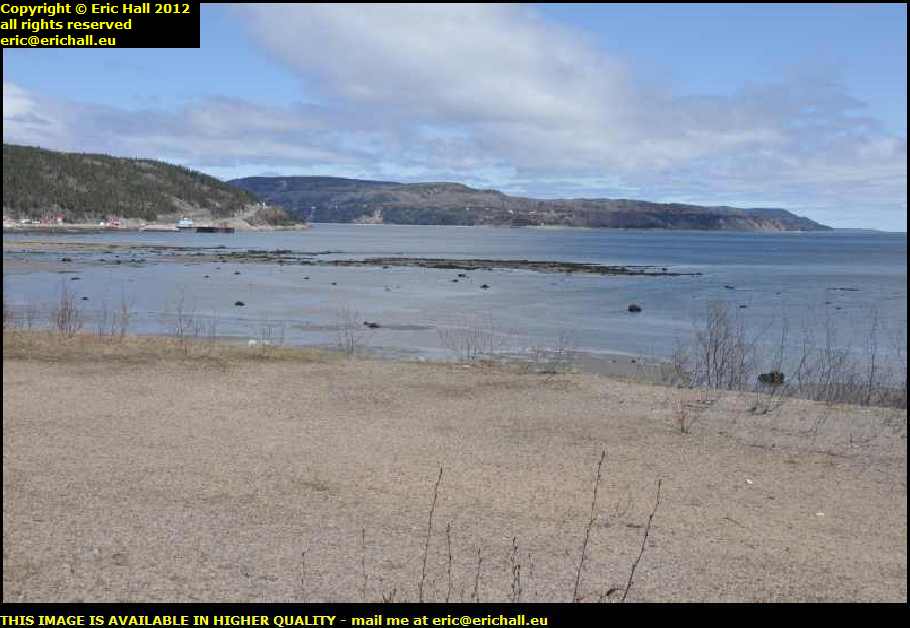
And, no, the sun has not miraculously just come out. We are still in May 2012 to be sure, but a week or so later and lots of things have changed, not least the weather, and we have some splendid views of the magnificent scenery.
In 2010, 2011 and 2012 we drove all the way along the coastline that you can see in the distance. And while the road didn't actually follow the coast very much, I didn't complain because the views made the effort well worth-while, as you will very shortly find out..

Over there across the river is the town of Tadoussac and I spent a night there on my little exploratory run-round in 2001 .
I haven't merged any of the details of that trip into the accounts of my subsequent journey as it was the first time that I had been here and it was right in the middle of winter, so I had many more things on my mind than simple tourism and sightseeing back then.
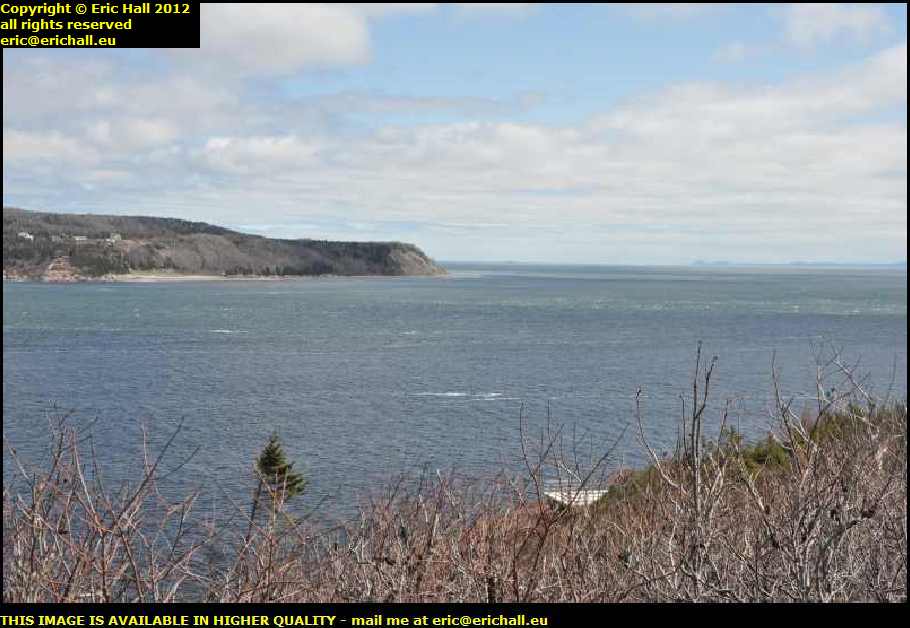
Tadoussac is famous for its beaches and dunes and once the coastal steamship lines established themselves along here in the mid-19th Century, the town became something of a tourist destination.
You can make out one of the beaches over there in the distance and in the gorgeous weather that we are having today it really does look inviting.
But don't be fooled by the weather. I have it on good authority that the water is so cold that just a few hundred miles downstream the Gulf of St Lawrence is still frozen up and the ice-breakers are out.
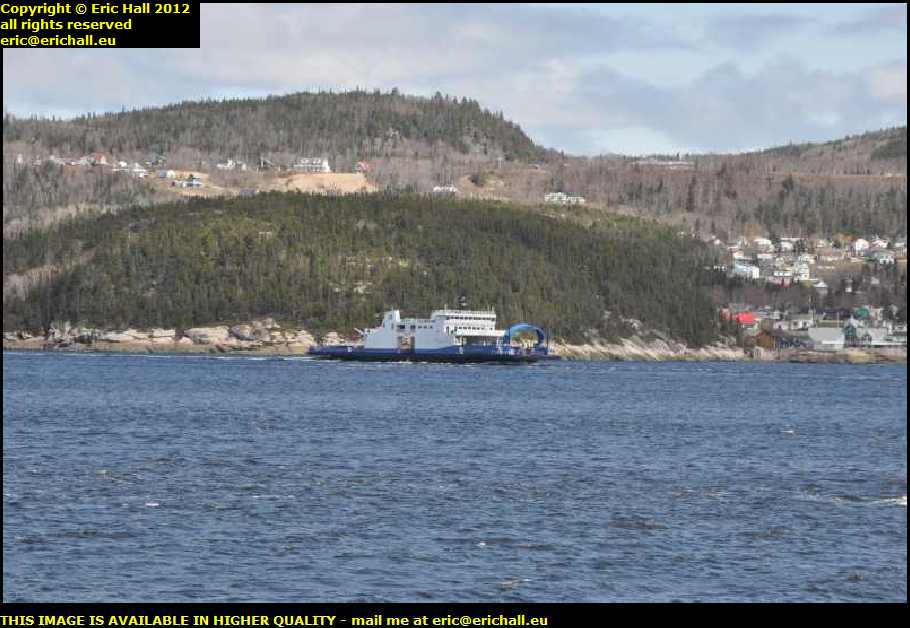
So how do we cross the saguenay River then? Yes, you've guessed. There is a ferry service that runs across the river and it will certainly be a sad day for me when they build a bridge here, as they surely must, sooner or later.
That is because, as you will very shortly find out, this is one of the most spectacular ferry crossings anywhere in the world and if there is anywhere better than this, then I have yet to see it.
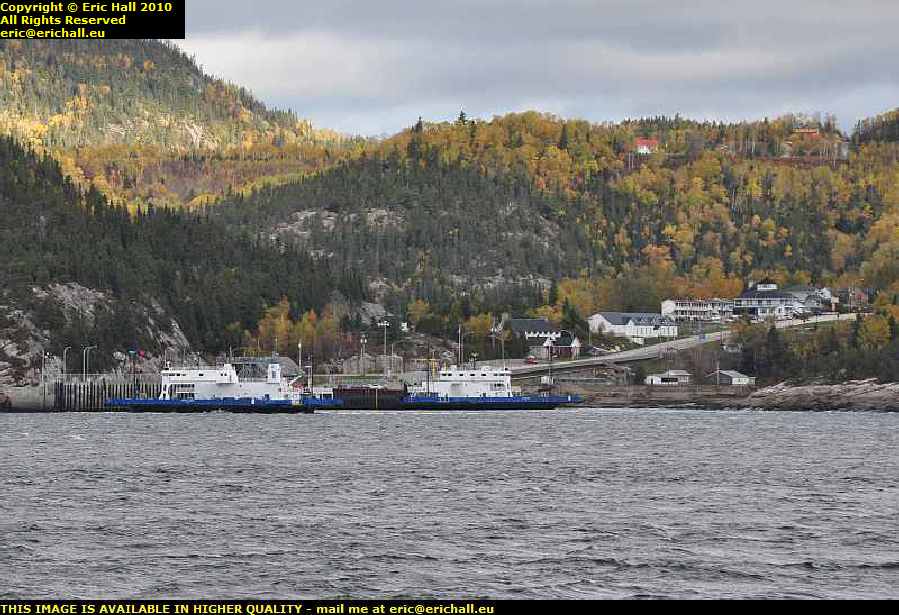
So while we are sitting in the traffic queue in October 2010 waiting for our ferry to come over, and gazing at the ramp that will take us up the bank into the town of Tadoussac, let me tell you just a little about Baie St Catherine, where we are currently parked.
It's important to know a little about the town because an even that occurred here very on in the history of Nouvelle France played something of a sinister, if not decisive role in the future of the colony.

Tearing your view away from the delightful little town of Tadoussac, I'll continue my story.
When Champlain explored the St Lawrence in 1534 and 1535 he encountered the native Iroquois and when he over-wintered on the North American continent his camp was quite close to an Iroquois village at what is today the site of the city of Quebec. By all accounts, the relations between the Europeans and the native Iroquois were fairly cordial.
Champlain and Roberval, at their little colony at Cap Rouge did notice a "deterioration of relations", but this was nothing compared to what was to happen later.
It was here at Baie St Catherine in 1609 that Champlain met Sagamo, the chief of the Montagnais, and the latter persuaded Champlain to form an alliance with several other tribes, directed against the Iroquois. Champlain's primary interest in Nouvelle France was trade and not colonialisation so, seeing as how the Montagnais were the leading players in the fur trade, he readily accepted.

This led to the 1st battle of Ticonderoga (about which I'll talk in due course) on 30th July 1609 where just three French firearms (supported of course by the native Alliance) put the Iroquois to flight.
The iroquois were, or course, not the kind of people to take this lying down. Realising that the French in Nouvelle France had upset the fragile balance of power with their firearms, they resolved that they would
And what we had was a bloodbath for 100 years where the soil of the St Lawrence, Richelieu and Hudson valleys was drenched with the blood of European settlers, not to mention the loss of life among the militia and their native allies. At one stage, we are told that
"at night, no-one dared open his door. Nor even by day, venture four steps from his house without gun, sword and pistol"
One nun of a religious establishment in Quebec went so far as to write that one particular onslaught upon the nascent colony of Montreal on 6th May 1651 had left the inhabitants "most upset".
And all of this because of a chance meeting here at Baie St Catherine in 1609.
The story of the "gun, sword and pistol" did however bring a little smile to my face as it did remind me of a famous quote from my hero and alter ego Sir Boyle Roche
"As I write these words, I am holding a rapier in one hand and a pistol in the other" - and presumably, therefore, the pen between his teeth.

As we watch my ferry pull up to the quayside, then what other claim to fame does Baie St Catherine have? Ahh yes, the Quest for an Ice-Free Port.
We encountered the Massif de Charlevoix railway a few times on our travels, but that is really a legacy of an earlier project.
The ports along the St Lawrence are iced-up in winter and as the interior of Canada was opened up in the seconf half of the 19th Century, an outlet had to be found for the produce of the new territories. One obvious solution was to export it via the USA but of course, for political reasons that was always going to be a non-starter
The second solution was to find a suitable site for an ice-free port along the St Lawrence and connect it to the national railway system. Baie St Catherine was seen as the most likely, and in 1881, the Quebec, Montmorency and Charlevoix Railway Company was formed to put this idea into practice.
Of course it never happened, and eventually after much huffing and puffing and a great deal of string-pulling by the dynamic Rodolphe Forget, the railway staggered into Clermont, on the outskirts of La Malbaie in 1919 to go no further.
By this time we had diesel-engined icebreakers, much more powerful that anything that could have been employed 40 years earlier, and so the urgency was past. But had the railway company been more determined, the view from here today would have been much different than this.

So with our discussion of Baie St Catherine being finished right on time, we can prepare to board our ferry. In 2010 it was the Felix-Antoine Savard.
I reckon that she's the biggest ferry on the crossing and she's only a seasonal boat. I'm lucky to be on her because tonight she's off the Quebec where she'll be laid up for the winter.
And I'm glad that I stayed in the car to talk to you about all of this because the sun, having moved around in the sky and throwing its light on the bluffs across the river, has left us in the shade and at the tender mercy of a bitter, freezing wind.
I'm on my way to Labrador as you know and I don't much fancy my chances if the weather continues like this.
©