 | NOVA SCOTIA |
CANSO

Ahhhh - this is what I am looking for. And like me, you might be overwhelmed by this building because if you haven't noticed yet, it's built of brick. And I sincerely cannot remember when it was, the last time that I saw a brick-built building during my drive around North America to date. I'm not even convinced that I saw one in Québec. It definitely suggests something non-Maritime, probably non-Canadian and maybe even non-American.
Where we are right now is a small settlement called Hazel Hill and this building is of important historical significance even if it is in danger of collapsing into the roadway. It was in fact the operational nerve centre of the North American end of the Commercial Cable Company's undersea cable between New York and Europe and was built in 1888.
We've spoken at great length about the transmission of messages across the Atlantic. In 1854 a proposition was made to lay a transatlantic telegraph cable between Europe and Newfoundland for the transmission of messages. The proposers were guaranteed a monopoly of transatlantic communication for 50 years and the cable was finally completed in 1866 by the Atlantic Telegraph Company once the considerable technical issues had been overcome and the turmoil of the American Civil War had ended.
Cable transmission of transatlantic messages quickly became an indispensible ingredient in trade and the dissemination of news, and the operating company had such a stranglehold on the medium that rival companies began to carefully check for loopholes in this guarantee. It was suggested that the "special status" of Newfoundland - a British colony at the time and also an offshore island - might not indeed qualify the cable as being a genuine transatlantic cable and the scramble was on to find somewhere else on the mainland of North America to where cables might be laid.
The nearest point on the North American mainland to Europe is just round about here at Canso (don't forget, of course, that Cape Breton Island really is an island) and three companies brought transatlantic cables ashore in the immediate vicinity
First to arrive was the Direct United States Cable Company, which brought its cable ashore at Tor Bay in 1874
On 23rd of May 1881 the Western Union Company brought its cable ashore at Canso
In 1884 the Commercial Cable Company brought their cable ashore at Black Duck Cove just a couple of miles from where we are standing right now.
The proprietors of the Commercial Cable Company were one James Mackay and one James Gordon Bennett. Mackay was a very wealthy individual who had amassed his fortune in the mines of the western USA and Bennett was the proprietor of the New York Herald.
One can immediately see some kind of symbiosis here - Bennett would be eager to have control of some kind of news medium between Europe and the USA to jealously guard his "scoops" and other exclusive news items, and Mackay would have the fortune to invest in the cable in the expectation of making a handsome return
And strangely enough, as soon as I heard the partnership "Mackay-Bennett", a light went on from a very distant memory in the back of my brain. Of course, in order to lay a cable, you need a cable-laying ship. And once the cable is laid, you still need a cable-laying ship on permanent standby in the vicinity in case the cable breaks, so that it can fish for the two broken ends, pull them up and rejoin them.
As you might expect, the Commercial Cable Company had such a ship, the Mackay-Bennett, and that was on permanent standby in Halifax Harbour. And when the Titanic sank, a ship was needed without a moment's delay to go to the scene of the disaster to fish for the bodies of those who died. There was only one ship in the vicinity ready to steam at short notice and that was the Mackay-Bennett. With it being a cable-laying ship with a low freeboard and a crew accustomed to fish for broken ends of cable, it was an inspired choice.
The Mackay-Bennett set sail for the scene of the Titanic disaster on 17th April 1912 from its mooring at Karlsen's Wharf at 2089 Upper Water Street, arriving at the scene on 20th April. She recovered 306 bodies, of which 116 were returned to the sea. With the remainder she then returned to her home port after 5 days and unloaded her grisly cargo at Coaling Jetty 4 (now part of the Canadian Navy dockyard). And it is for this reason that many of the victims of the Titanic disaster are buried in the cemeteries of Halifax.
And so back to out story. With the Commercial Cable Company setting up its business here, it needed staff to run its operations. This staff had to be technically-minded, well-educated, and willing to undertake sedentary offic work. This meant that they had to come from outside the area of Canso and the company saw fit to recruit and train its staff in Europe.
Canso in the 1880s was a completely different environment that it is today, and a completely different environment from the environment of that milieu of "cultured Europeans" the period. The company did everything that it could to make its employees here feel at home out here in what was for its employees an inhospitable environment, hence inter aliathe brick buildings.
Initially the system was battery-operated, and I have not been able to find out how the batteries were recharged. But with the advent of the commercialisation of electricity, these cable stations were powered by mains electricity. In fact, one of the benefits that the cable companies brought to the area was that mains electricity arrived here much earlier than most other places in rural Nova Scotia. Here at Hazel Hill the "mains" was switched on in 1912 and Canso was connected in 1914. Compare that with lonely (but not by any means isolated) areas of the UK that didn't receive electricity until 1955
Nothing lasts for ever of course, particularly in the domain of technology, and advances in communication after World War II led to the system of telegraphy being superseded by that of the telephone. There was no longer any need for the batteries of telegraph operators here and the company pulled out of Hazel Hill in 1962.
Like most other places in Canada, the abandonment of the town by the company has led to the abandonment of the company's premises. There is no-one willing to take them over, nor is there much prospect of any new industry coming to the area to create further employment.
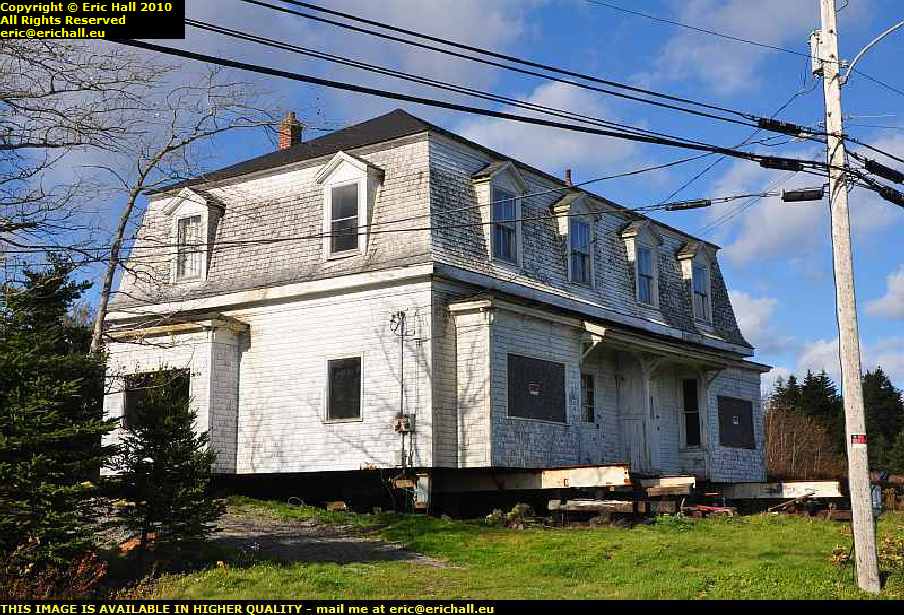
There are places like Hazel Hill all over Canada where derelict buildings tell a story of former glory that has long-since passed by. And this house is intriguing me. What is it doing up on jacks like this?
It looks very much like ths situation at Cape Hatteras where every so often they jack up the lighthouse and move it further inland as the sea erodes away the peninsula. But if the sea is eroding away the peninsula just here then we are having more problems with global warming that I thought.
On my voyage all around Labrador and Newfoundland I've been passing comment on the culverts that they use to run water under the roads. Most of the culverts have been made of steel and I've been regularly passing comment about their potential longevity, and wondering why they haven't used concrete culverts.
Fair enough - in Labrador I can understand (although that is not the same as saying that I agree with) the idea - concrete culverts are heavy and the logistics of transporting them all that way are not so easy. Nevertheless, they are still using steel culverts in Newfoundland and we've seen the result and the subsequent inconvenience even though there are nothing like the same transport difficulties as they have in Labrador.
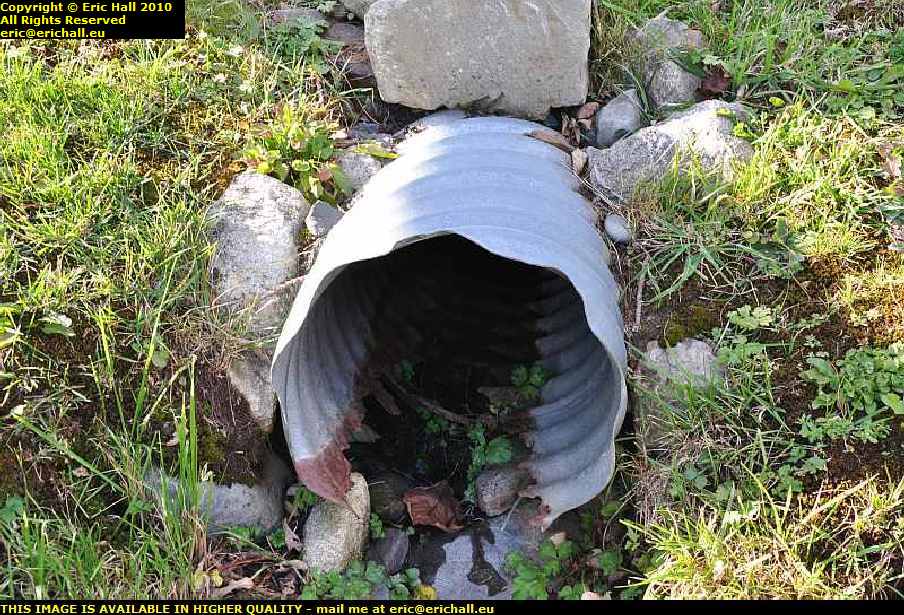
Here in mainland Nova Scotia where there are no such difficulties at all, they are also using steel culverts and in this photograph you can see exactly what I mean by the longevity issues.
This particular steel culvert has rotted right the way through and once the circular form has been lost, the rigidity and hence the strength of the culvert is lost. It's not going to be very long before they will have to replace this one. It's very short-sighted building these things out of steel.
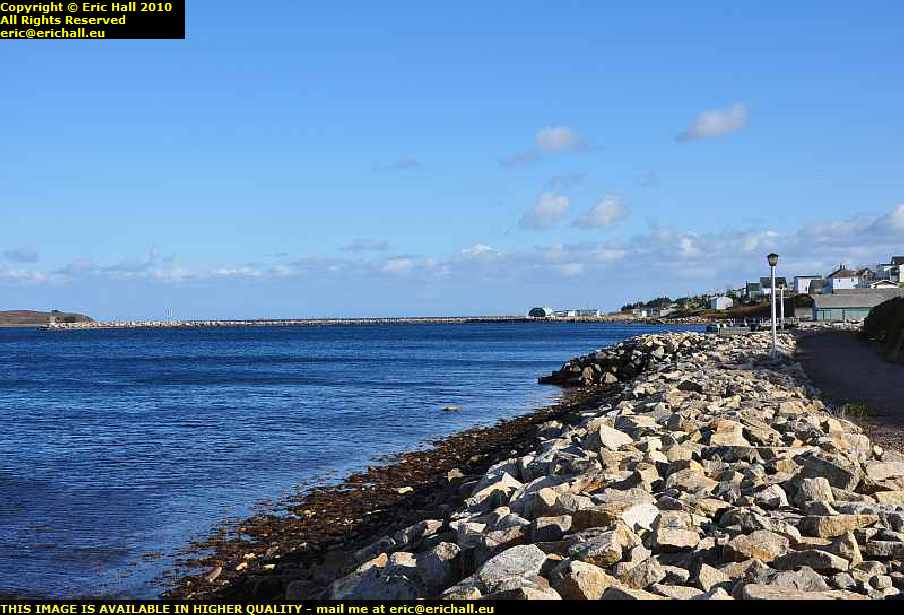
Here I am finally at the end of the road - or at least the end of Highway 16. This is Canso and as I mentioned when I was discussing the telegraph station at Hazel Hill, it is probably the closest point on the Canadian mainland to the UK.
It is said to be one of the earliest places in North America to be settled, with some kind of fishing station being established here in the wake of John Cabot, although of course, as we said just a short while ago, much circumstantial evidence exists that can be used to build up a reasonable case for the presence of West Europeans on the coast of Canada during the period between its abandonment by the Vikings and its rediscovery by Cabot.
Like almost everywhere else on the coast of eastern Canada, the sea played a leading role in the history of the town. As I mentioned, it came into being as a fishing settlement. Fishermen, mainly French, would come here in the spring to fish for cod and other types of fish. Their catch would be laid out to dry in the sun and then at the turn of the weather in autumn the fishermen would return to their homes in Europe with their catch of dried fish.
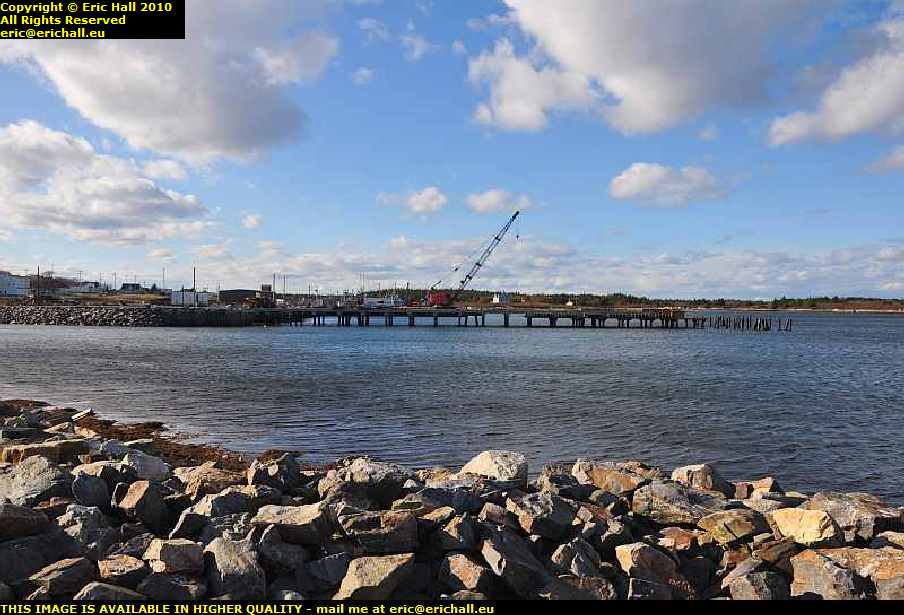
Over the follwoing years the settlement slowly became permanent and the fishing industry expanded at such a rate that by 1728 it was said that there were 250 boats and almost 2000 men working out of here.
It was anything but easy, though. A history of Canso in the 18th Century is nothing but a catalogue of war, slaughter and destruction. Not only were the English, the French and the Americans fighting desperately, if not savagely, for supremacy in this corner of Nova Scotia, there were regular and persistent raids, often of a very violent nature, by Native Americans, and even pirates such as the notorious John Paul Jones joined in the (af)fray
Such was the situation that following a visit by the Governor of Nova Scotia in 1719, in which he described Canso as being
"by all accounts the best and most convenient fishery in any part of the King's dominion",
he caused a small garrison to be stationed here permanently.
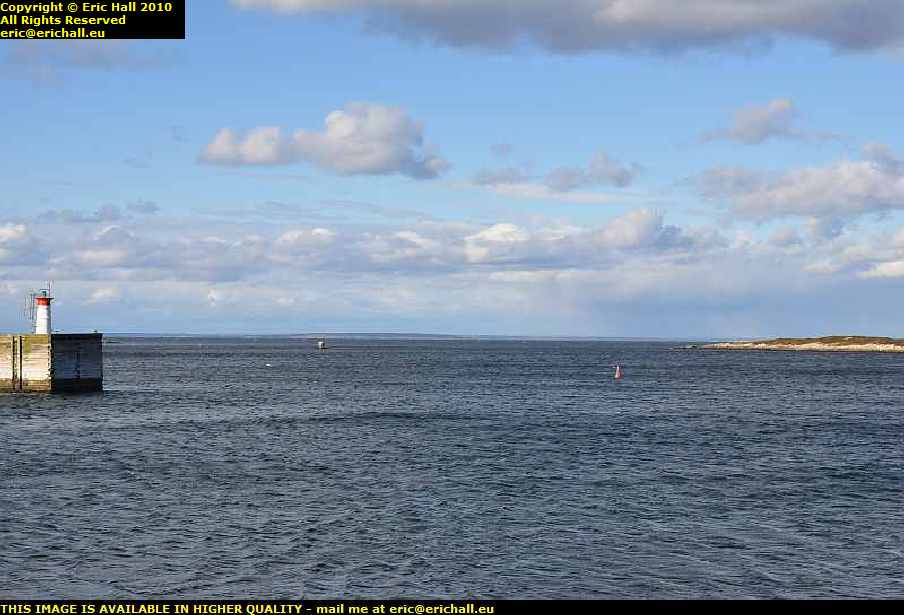
This led to the construction of a fort on Grassy Island in the mouth of the bay just there (with the coast of Cape Breton Island away over there in the background) but that did little to prevent the attacks. In fact in 1744 a French expedition from Louisbourg on the Cape Breton coast sacked the town, destroyed the fort and captured the entire garrison.
The subsequent British expedition to capture Louisbourg assembled here in the bay in 1745.
And this of course reminds me of a story I heard about an American tourist in the area chatting to the locals one early evening
"And when was it again that the French destroyed the fort on the island?" he enquired
"1744" replied a helpful local
The American glanced at his watch and then turned to his wife "Darn it! We just missed it!"
It says a lot for the potential rewards to be gained from the sea off the coast of Canso that despite everything that everyone could throw at the area (and the catalogue of attacks on the settlement is astonishing - I've never seen anything like it) people still flocked here to try to make their fortune from the sea.
And the fact that many of them did so despite the frequent interruptions is witnessed by the statements of losses and damage recorded after the raids. In 1720 a raid by the Native Americans, supported by the French, is said to have led to the looting of property to a value of $80,000 - a fortune in those days.
Of course it couldn't continue and a garrison sent here to protect the coast during the War of 1812 recorded just 5 families in the area. What a decline that was from the 2,000 men here in 1728.
And of course, while we are on the subject, I spent a few years living in the town of Winsford in Cheshire - a strange town half-occupied by the locals (the "Woollybacks") and the other half occupied by Liverpool overspill (the "Scousers"). Such was the nature of the town that when on one certain evening the Scousers went on the rampage in the Woollyback part of town, they caused over £1,000,000 worth of improvements.
As an aside, do you know why Native Americans are commonly referred to as "Indians"? It's nothing at all to do with the popular idea attributed to Columbus that the continent of America was really India. In fact it's a corruption of the French word indigène meaning the original inhabitants, from which the English word indigenous comes.
Once the War of 1812 had been settled, peace broke out in this part of North America and the population slowly returned. Of course fishing played a leading role in this but as I also said earlier it was the arrival of the transatlantic telegraph cables, notably that of the Western Union that came ashore here in 1881 but also of the Commercial Cable Company up the road in Hazel Hill in 1884, that added a great deal of fuel to the fires of industry.
Canso's most famous inhabitant was undoubtedly Frederick Creed. He wasn't actually born here but he moved here as a young child. As you might expect, he worked for a while for the Western Union and his claim to fame is that he invented the first form of what is today known as the teleprinter.
The collapse of fishing and the ending of the telegraph have led to the end of Canso's role as a leading player in the economic life of eastern Nova Scotia, but then again this can be said of almost anywhere on the Canadian east coast. Canso now makes its living as the base for most of the services for the population of the area. There's a hospital here as well as banking establishments, a High School and some of the larger and more specialised shops.
I read a report written by some local schoolkids, in which they expressed the belief
"that in the future Canso will resume her former position of importance in Nova Scotia"
Not that there's ever going to be much chance of that, despite their admirable optimism, unless someone discovers a major oilfield just offshore. That's all that people seem to be interested in these days.
If it were left up to me I would have the world's biggest windfarm just here. The wind along Canada's Maritime coast is savage and the almost-total absence of wind turbines is something that borders on the astonishing. People here are sitting on a goldmine if only they would actually do something about it.
There's only one place left to go to now down here and that is to Black Duck Cove
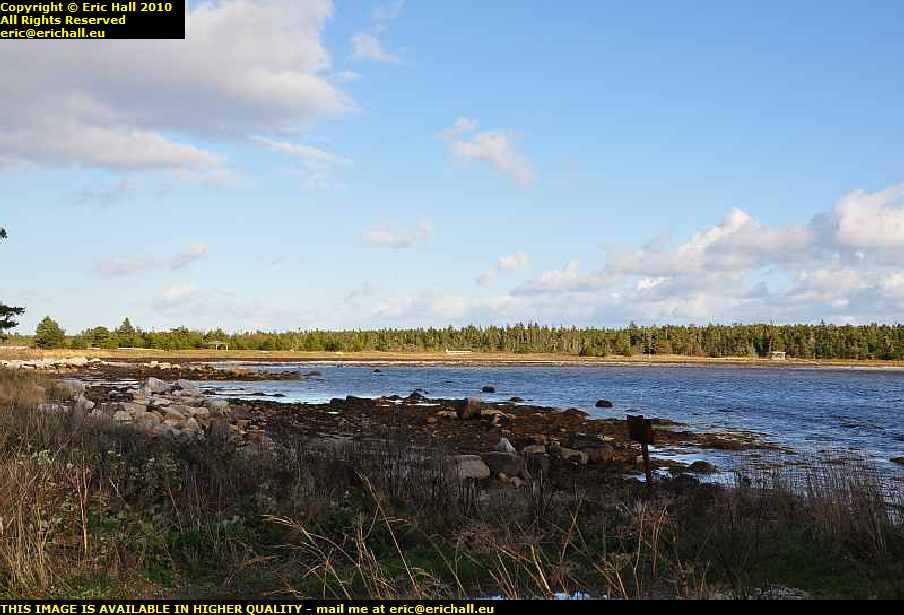
And why Black Duck Cove? I hear you ask, and that is because it was here that the telegraph cables for the Commercial Cable Company came ashore. I heard it mention that 25 years ago the cables were still visible and I wanted to see if this was still the case, but if they are still here then I couldn't see them.
There were a couple of little cabins over there on the far shore but I couldn't work out how to transport myself over there to see whether they might have had something to do with anything. I'll just have to come here again.
What there was here though was something else of interest that I found while I was prowling around and I'm surprised that I didn't photograph it.
Do you remember a few weeks ago when I was up on the Upper Québec Plateau at that abandoned town - Gagnon - that's the one and as I was driving along probably the only piece of dual-carriageway road north of 51°N, I talked about this plot of land with some wierd swan-necked pipes sticking up out of the ground? Well, there are some here too at Black Duck Cove.
I had a good look around the installations but I couldn't see any kind of plate or sign to indicate who owns it or what might be its purpose, and there was no-one around to ask. I wonder if it's significant that both of these installations that I have now seen have been very close to water
But I'm surprised that I didn't photograph it.
From here I'm now going to be heading along the southern Nova Scotia coast towards what in my opinion is the most beautiful city in the whole of North America - Halifax. Mind you, it's a long way away from here and what with my frequent stops it'll take a day or two to arrive and so the quicker I start, the quicker I will finish.
I have to drive back quite a way along Highway 16 and then turn onto Highway 316 to follow the coast.
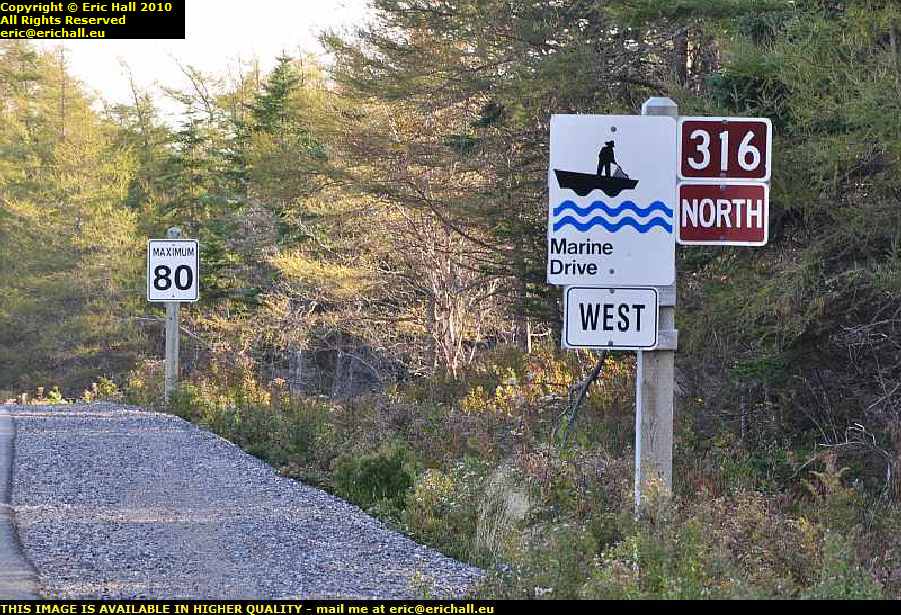
This is where you need to turn and I include this photo for the benefit of those casting aspertions on my articles saying things like "I don't have a clue where I'm going or what I'm doing". With road signs like this along the route that I'm taking, is it really any surprise?
A schizophrenic's paradise one might say, and I couldn't agree more. One thing that I have learnt is that you are never alone with schizophrenia. But I suppose that this road junction is specially designed for members of the hippy community - "Hey man, let's split"... "are you going to stay here all night?" ...ed.
Right, so I'll move on, leaving you with the words of a man who is without doubt my hero and inspiration, the legendary Sir Boyle Roche
"a man cannot be in two places at once, unless he were a bird".
©