 | CANADA - |
ST FELICIEN
In the early evening yesterday, I pulled into the town of St Felicien, which isn't too far from Roberval which was my intended destination had I not been so sidetracked.
In view of the time, I'd been trying to find a place to park up for the night but without any success whatsoever - you have no idea just how built-up this area is and there was no convenient nook anywhere.
There's a zoo here at St Felicien on the edge of town and there's a campsite almost next door, so I wander off there to find a place to camp. As you might expect, however, it's closed until the summer. The nearest open campsite is an hour's drive from here (see, even I'm doing it now!) and it'll be dark by the time that I arrive.
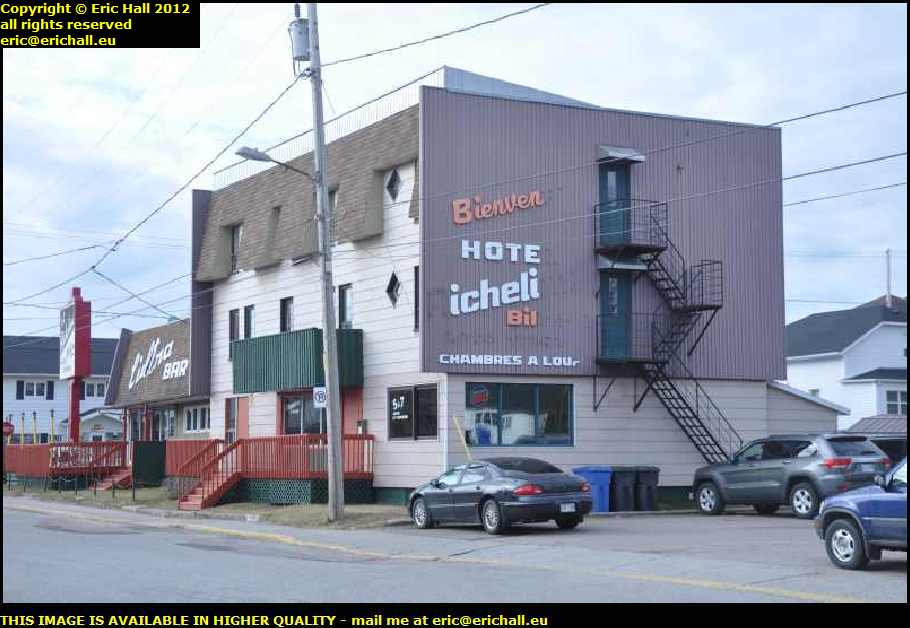
All is not lost, however. There's a hotel here with a vacant room at, would you believe, a mere $42 per night. There was a room that was even cheaper than this but "there's someone already in it".
"Well," I replied, "If it's a nice young female that will be OK"
"It's a couple actually" said the cashier
"I'll have the other room then" I retorted. "I'm not into things like that".
Never mind. I bite the bullet and sign myself in. No payment by bank card - it's cash only. And the cash machine didn't like any of my cards and so I had to go chaud-pied as they say around here to the nearest bank.
As for the hotel itself, it's something of a dive, and there's no internet connection either. However, I will point out that I've stayed in far worse places than this in the past and for much more money too.
Next morning, despite my concerns of the previous evening, my boots were still here. Even more importantly, so was I. And I was up bright and early too after a good night's sleep.
I spent a pleasant hour or so catching up on my notes and photographs and then in the best tradition of a reporter from the much-lamented "News of the Screws", I "made my excuses and left".
As for the Hotel Richelieu, "basic" is the best way to describe it. "Olde-worlde" is another. "Worn and tired" is a third. But before anyone is carried away by what I have written, let me make the following point clear.
I'm a budget traveller on the economy plan. I know what to expect in places like these and I also know what "value for money" means.
The acid test for anything when it comes to budget economy accommodation is whether or not I would stay here on another occasion at the same price. The answer to that question is in the affirmative. I had good value for money here.

Dumping my stuff in the Dodge and going for a walk, I come across the most astonishing of signs. It's not about an immeuble of course, or a batiment either. However, to my surprise, neither is it about an edifice.
It seems that here at St Felicien we have a batisse for sale and that's a new one on me in Quebec. I'll have to keep my eyes peeled for any more examples of this and if I can find some, I'll add this to my "Teach Yourself Quebecois" course.
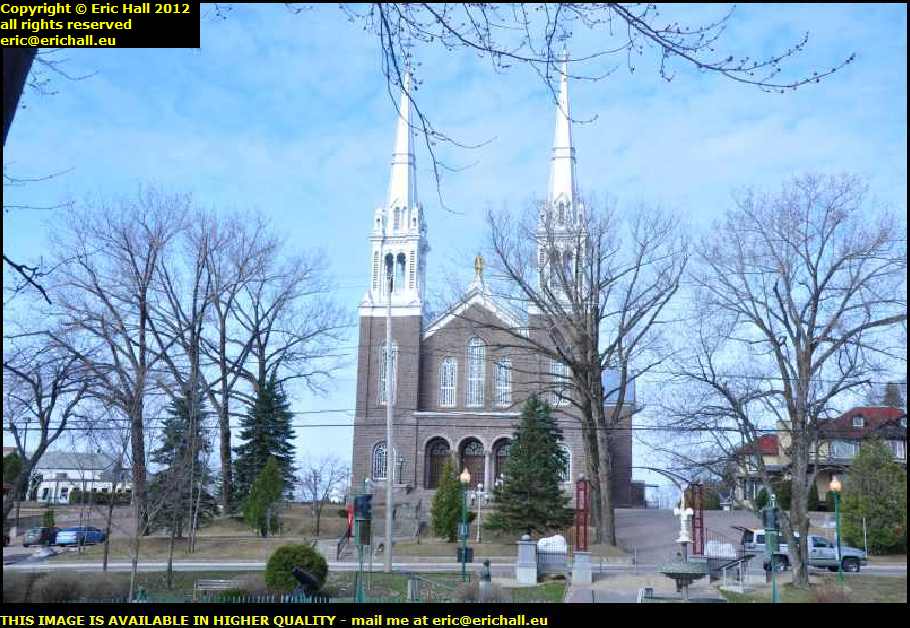
As I keep on saying, the church is always the focal point of a built-up area in Quebec and so that was to where I headed. There's a good view of the aforementioned from the park across the road.
The church itself dates from 1914, but seeing as how the town was founded in 1865 when the first colonists arrived (although fur traders had been here for centuries), I reckoned that there would have to have been a previous church.
I did wonder about that. Had there been a previous church and what had become of it? Anyone who has spent any time at all in Quebec would be able to make a reasonable guess but whether or not they would be right is another story. I couldn't find out any information. It didn't escape my notice that the church is built out of granite and not the more-usual wood.
In fact there has been a major fire here in the town, and not just any old major fire either. On 19th May 1870 a fire broke out in the town and went on to destroy everything, absolutely everything in its path, all the way southwards as far as the Saguenay Fjord. It took years for the region to recover.
On the subject of the park, I can't show you any photos because access is not possible at the moment. It's all fenced off and there are workmen busily doing all kinds of things in there.
That's quite a shame because it's quite a pretty place with a fountain that looks as if it could be quite spectacular but it's not working at the moment while the park is undergoing renovation.
The story behind the park is that originally it wasn't a park at all but a huge ravine. In 1929 the local priest persuaded all of his parishioners to bring all kinds of stuff in order to fill in the ravine to level it off with the surrounding land so that the town could have an urban park.
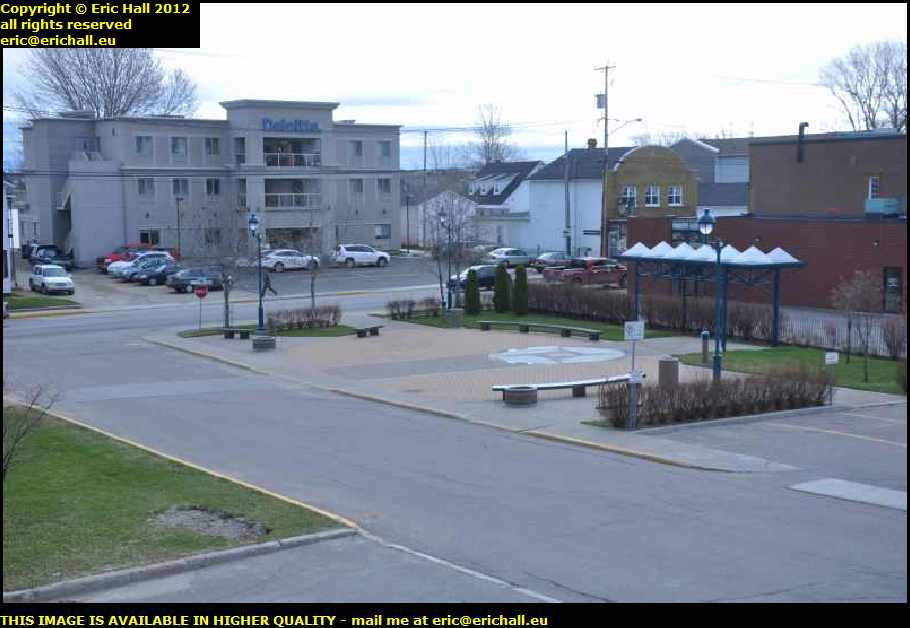
There's a nice little square in the centre of St Felicien and from the top of the church steps there's quite a good view of it. While you pause to admire the view it gives me an opportunity to tell you a little more about the town.
The site was known to the courers de bois, the Europeans who came to the area mainly by water to trade for furs with the Native Americans following the successful voyages of Cartier and Champlain. However, it was not until 1865, as I said earlier, that the region began to be settled by Europeans.
These early settlers were mostly concerned with agriculture and this is no surprise, as we have seen during our voyage around the other side of the lake. Forestry products were important too although it wasn't until 1978 that the first large-scale pulp mill was created here.
In the meantime, the wartime quest for minerals in the Canadian Shield had led to the discovery of gold, as well as impressive amounts of copper and zinc, at Chibougamau, 240 or so kilometres upriver.
The construction of a winter road between St Felicien and Chibougamau in 1950 enabled the minerals to be exploited and today, St Felicien serves as a trans-shipment point for the output of the mines and also for the demands of the miners.
All of this has led to a growth of population to about 10,000 inhabitants today.
All of the foregoing made think that there may well have been a railway line here at St Felicien - remember that we've seen some evidence at Chicoutimi and convincing evidence at Dolbeau that there is some kind of railway infrastructure in the region - and so I set off on foot for a prowl around.
Sure enough, in a hollow on the edge of town there's what looks very much like a railway overbridge and so I haul myself up, and here I am.
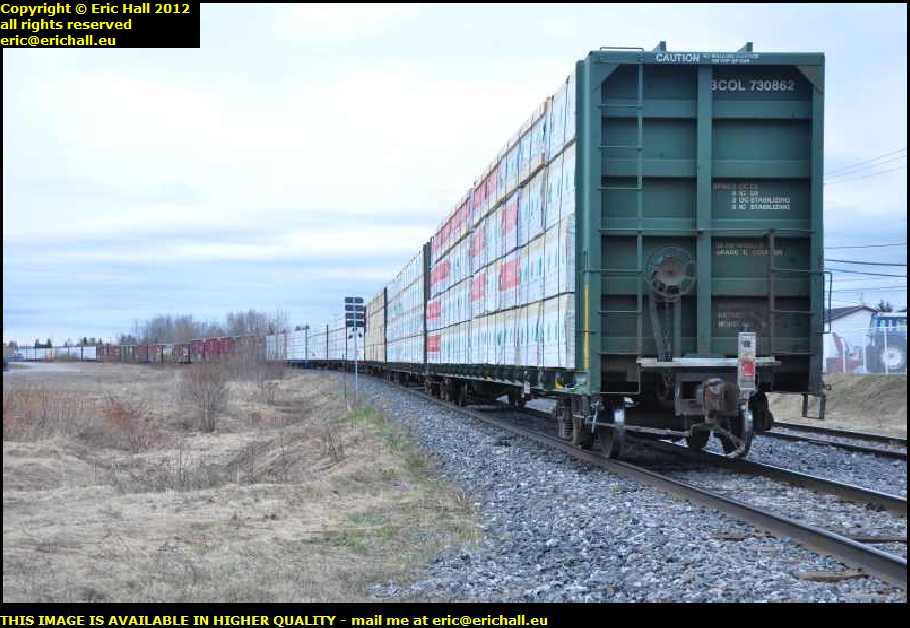
I was right. Not only do I stumble upon some railway tracks, but there is also a pile of rolling stock. This line might even still be active.
So where does the line come from? I thought at first that it might have been a continuation of the Massif de Charlevoix
coming from La Malbaie, but in fact there's a Canadian National line that comes up to here via La Tuque and runs for some way around the lake.
Hearing a humming in the distance, I gathered that there might well be something going on at the business end of the train and so I set off along the track for a look.
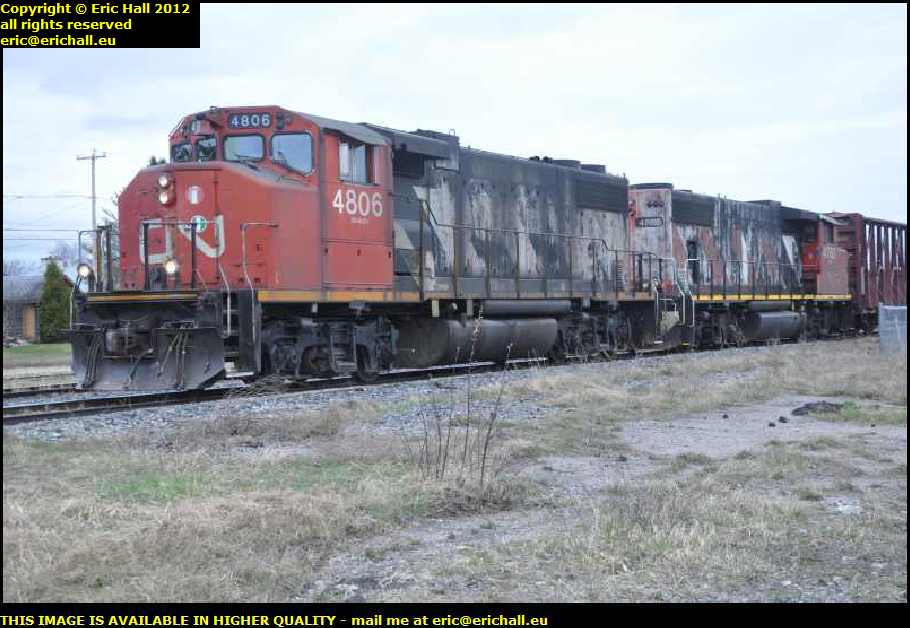
Sure enough, the line is indeed still active. Here at what is the front of the train, we have a couple of Canadian National locomotives, 4762 at the rear and 4806 in the lead, complete with snowplough blade.
According to my Jane's Train Recognition Guide
These two are probably 40 years old, and that, together with the fact they and their brothers are almost all still in service, is a testament to their reliability.
The W in the model specification, which many people think stands for "wide cab", but doesn't, is a specification used by several, mainly Canadian, railways for a higher-spec cab which was drawn up by Canadian National after consultation with the company's employees, and that must surely be a first.
There's more room to move about inside the cab, something pretty important when you realise how long a driver has to stay behind the wheel. He needs to be able to stretch his legs. The windows are heated and the draughtproofing is much better.
The front of the cabs are built of steel almost half-an-inch thick and specially reinforced, which gives the crew a much greater level of protection in case of collision with fallen trees, avalanches and moose, not to mention charging elephants (and I bet that you think that I'm making up this last bit too)
They very kindly hung around for their photo shoot and once I had finished, they upped sticks and cleared off. I recorded them on the dictaphone and one day I'll work out how to extract the file so that you can listen to it. .
As an aside, many of you will recall my theory, that I have expounded at great length and on a great many occasions too, that a North American goods train is a quarter-of-a-mile long per locomotive . Having walked down the side of this train just now, I can confirm that there's not much wrong with my calculations.
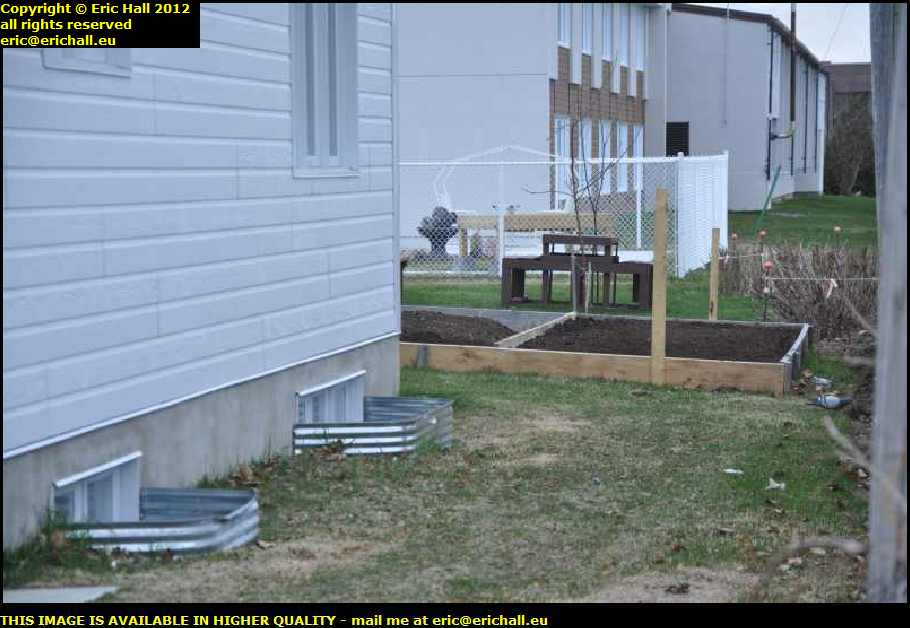
While I was up here at the railway line at what was presumably the site of the railway station in the days when North American railway lines carried passengers, I noticed that someone is going to be trying his hand at a spot of gardening this year.
Whoever it is has obviously been listening to my gardening programme on Radio Anglais. I'm a big fan of raised beds as you know. But it's not a new idea by any means, and in any case growing crops in the bare soil in a region such as this would be something of a thankless task.
Back on the main road I stumble upon a coffee shop and realising that despite the time, I've yet to have my morning coffee, in I go.
Daily papers are available for the customers in here and so I grab hold of today's Le Quotidien to see what it is that I've missed this last few days.
Apparently the next trainer of the Montreal Canadiens "will speak French". And you will have noticed that I did not say "will be a francophone" because that isn't what the paper says. It implies that the previous trainer was not able to speak French, and so I wondered what the Quebec authorities had had to say about that - a business in the Province conducting its activites in English.
Of those huge industrial plants that I saw in Alma yesterday, one of them at least is an ALCAN plant - the Aluminium Corporation of Canada. I did say that there was an enormous amount of hydro-electricity on tap at the head of the riviere Saguenay and the smelting of bauxite is one of the most energy-voracious commonplace industrial processes, so that makes sense. According to Le Quotidien, the local ALCAN plant is in dispute with Quebec Hydro about financial matters.
Two Welshmen in Australia have been found guilty of kidnapping an animal and taking it to their hotel room. The animal in qiestion? Yes, you guessed. It was a ... errr ... penguin.
Such are the news headlines here in Quebec.
Something else that I gleaned from the paper is that there must at one time have been a railway station at Jonquiere, a town to the south of here. I can tell you that because the man who lived in the Station House has just died and his funeral arrangements are in the rag.
Heading back to town, I notice that most of the cars here, even the petrol-engined ones, seem to be fitted with block immersion heaters, judging by the electrical sockets that I've seen dangling down underneath them.
Now there's a thing. Doesn't that give me ideas?
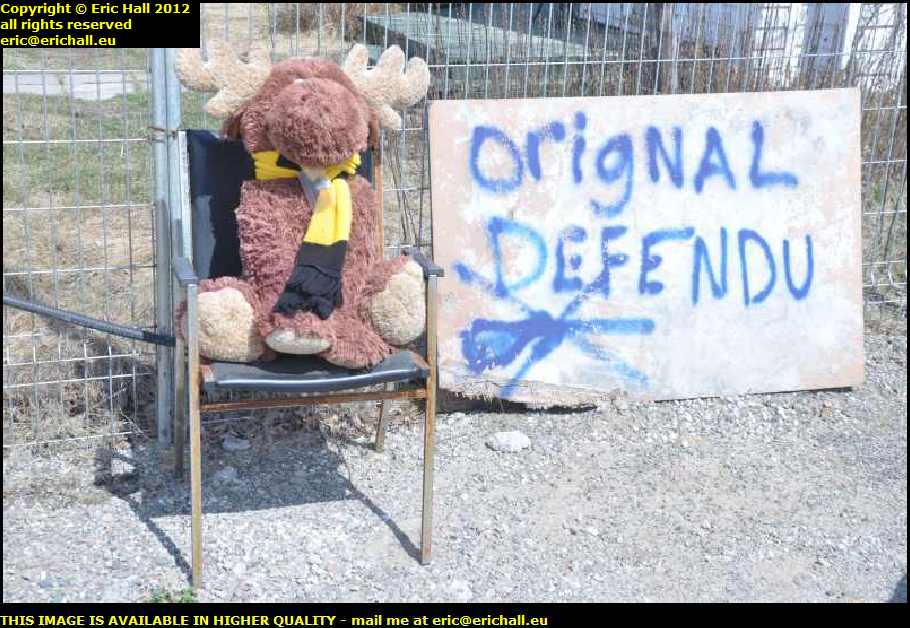
There's some kind of campaign going on in the town, organised by someone living here, to ban moose or something like that. Clearly, someone had heard about Strawberry Moose planning on coming here, so I reckon that it is probably an angry father, a cuckolded husband or an outraged young lady.
His Nibs does however take advantage of the chair that someone has thoughtfully provided. He'll never miss out on a photo opportunity.

Of course, His Nibs is quite capable of launching campaigns of his own, and we aren't talking about publicity campaigns or anything like that either.
There's a convenient vintage cannon on display in the town centre and he immediately goes into action, firing a couple of dozen rounds of ammunition at the town in revenge. Something of a loose cannon is our Strawberry Moose. There's not been a serious fire in the town for a considerable number of years so this should rectify that issue.
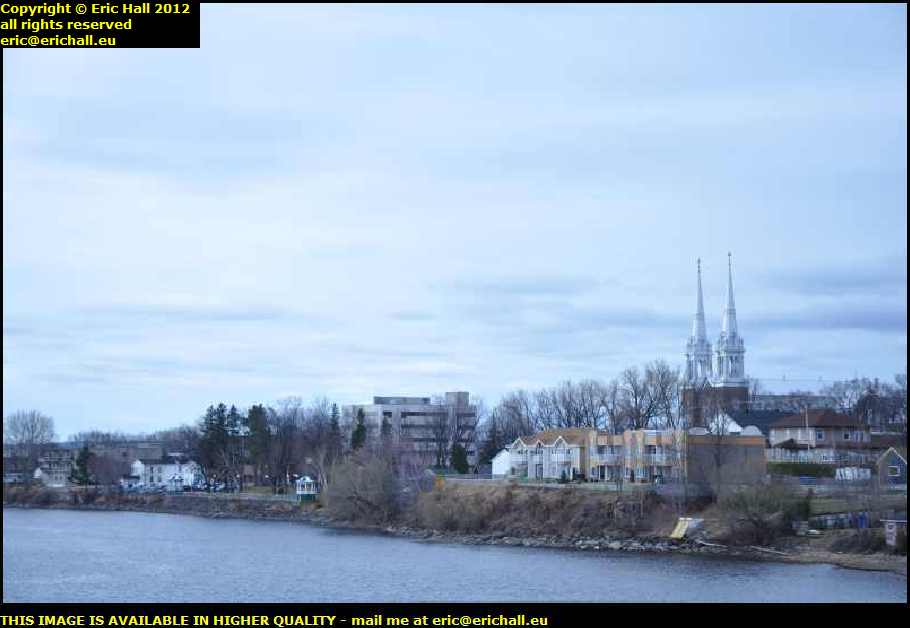
When I arrived at St Felicien last night, I came in from the north across the riviere Ashuapmushuan, and I hope that I've spelt its name correctly too. That river is 266 kilometres long, and is one of the most important feeders into lac St Jean. In the daylight, I can go back to have a look at it.
There was formerly a covered bridge over the river (I'm not going to write out the river's name a second time) here. and not just any covered bridge either but one that was 1233 feet long, which would make it one of the longest covered bridges in the world (The Hartland Bridge , currently the world's longest surviving covered bridge, is often quoted as being 391 metres long, which makes it about 1282 feet in real money )
The bridge was built in 1909 but was swept away in a "disaster on the river" on 26th April 1942, and I once saw some delightful photos of locals struggling to get themselves and their vehicles across the river on what looked to me like a very rickety pontoon bridge.
A new bridge was opened on 9th July 1945, a modern steel one as the locals didn't want a new covered one, and it's this bridge, modernised and rebuilt in 1989, that is the one that is here today.
I would have shown you a photo of it but it's currently undergoing another process of modernisation and widening, hence it's all fenced off. There are portakabins and machinery everywhere, piles of diggers all over the place, endless queues of cars and you can't even see an inch of the briidge's superstructure.
Final port of call in St Felicien is the town's Tourist Information Centre. The people at the Hotel last night told me that there was a free public-access wifi connection there, and they were not wrong.
Here, I'm delayed for a couple of hours. There are almost 400 photos to upload for a start, not to mention a week's worth of blog entries to mke and a pile of e-mails to read.
©