 | CANADA - |
RESERVATIONS
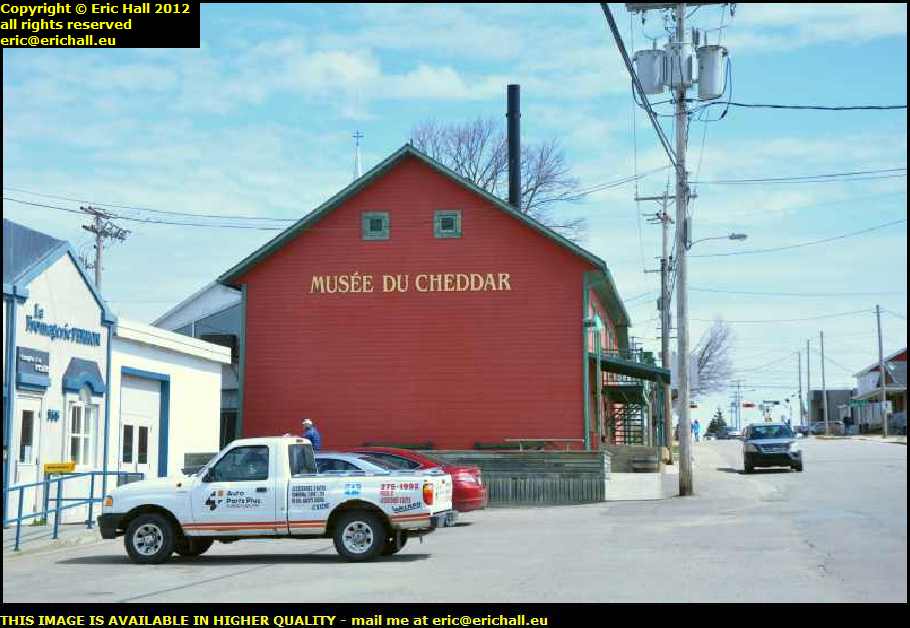
Back on the road, I saw a sign to the town of St Prime indicating that there was a Musée du Cheddar there. Even though, being a vegan, I don't eat cheese, cheese being made to a traditional British recipe is something quite noteworthy and well-worth supporting.
I was however under no illusions. Long-term readers of this rubbish will recall that my usual luck is such that I'll drive hundreds of kilometres to visit one of the most important historical locations in the world, only to discover that it's closed .
Driving a few kilometres out of my way to find another closed tourist attraction is therefore something of no importance. In fact I did it especially so that I could have the privilege of saying to myself "hard cheese".
I should mention that the museum is right next door to a cheese factory. Where there's a cheese factory there must be milk, and where there's milk there must be dairy cows. They wouldn't bring all the milk in by train in order to make the cheese and then take the cheese back out on the train.
There were several cheese factories in this area at one time apparently and this does underline the importance of agriculture in the area around the lake, as we have been observing on our travels. Today, however, this cheese factory, dating from 1895, is the last one of its type remaining in the Province.
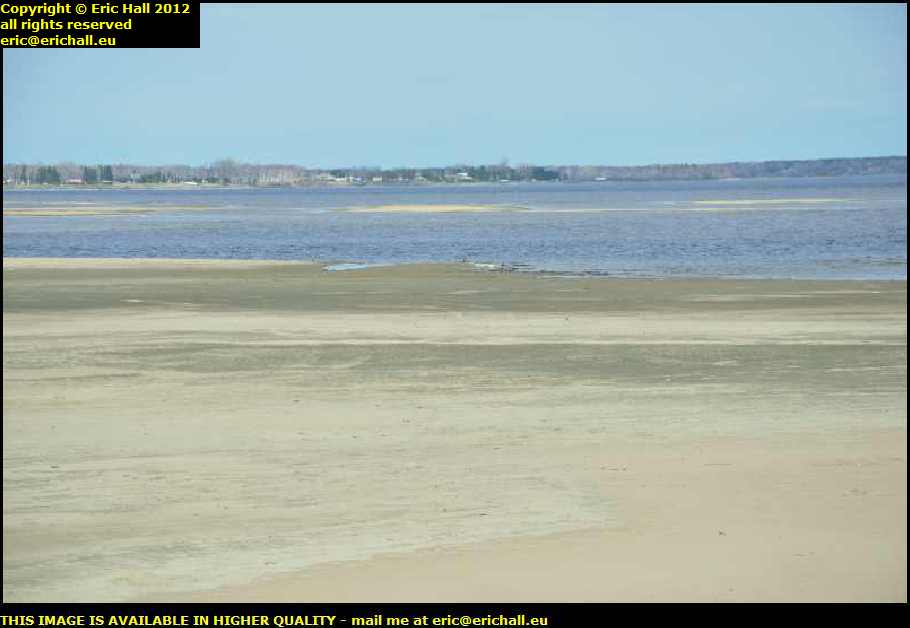
St Prime also has a lakefront and furthermore, there is public access to the beach here. I'm not going to miss out on this opportunity and so, paying no regard to the time, I park up the Dodge and go for a walk along the sand.
You might not think it by looking at the photos but this is quite a popular place to be. And I'm not just talking about modern times either. Along the lakeshore, archaeologists have apparently found traces of settlement dating back 3000 years.
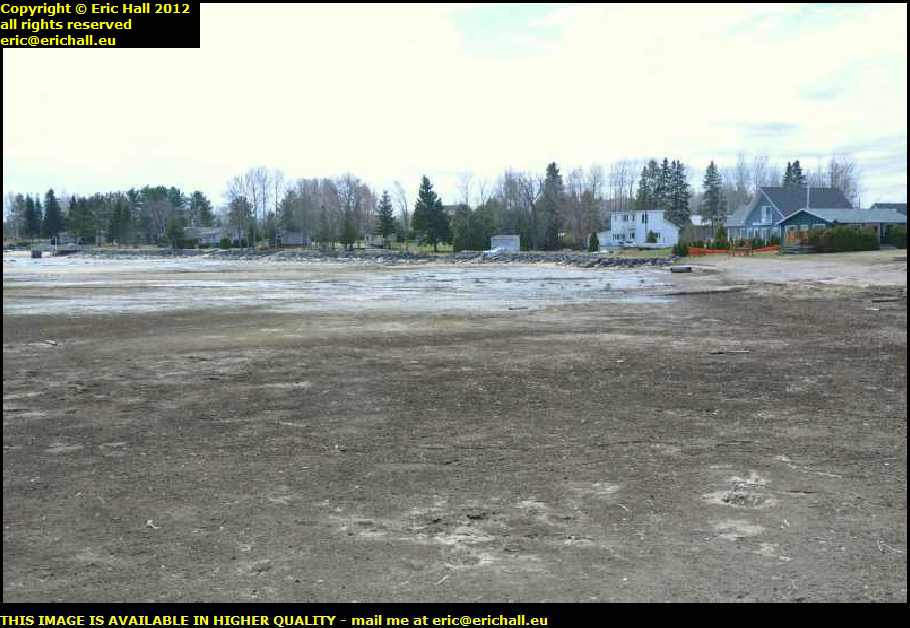
And not only that. There have been further archaeoloogical discoveries that have provided plenty of evidence of the interaction between the First-Nation Canadians and the Europeans dating back almost 500 years.
It is known that our old acquaintance Jean-Francois de la Rocque de Roberval, whom we encountered at Vieux-Cap-Rouge several days ago, led an expedition to the Saguenay in 1543 but no-one is quite sure of how far he reached.
Official credit for the discovery of Lac-St-Jean by Europeans is always given as 16th July 1647 when Father Jean de Quen reached the lake. De Quen came from the Saguenay Mission which had been created by the Jesuits at Tadoussac, at the mouth of the Saguenay Fjord, in 1603.
However, in 1600, Pierre Chauvin had created a trading post at Tadoussac, for the purpose of cornering the local market in beaver pelts. In his dealings with the Montagnais, it's more-than-likely that Chauvin and his associates, being skilled in their profession as traders, would have interrogated the Montagnais thoroughly about the sourse of their furs and thus became aware of the lake.
If that were indeed the case, it's very probable that some of his coureurs de bois, anxious to exploit the market even further, would have made trips up the Saguenay Fjord to see from where the beaver pelts were coming and to cut out the middle-man. It's impossible to miss the fjord of course, and it's only a simple portage from the end of the fjord to the lake.
As for their silence about whatever they might have discovered, they wouldn't want any details to fall into the hands of compteing traders.
And silence about trading discoveries is nothing new. It's certainly true that the Merchants of Bristowe in the 14th and early 15th Century were offering beaver pelts onto the market that had been treated in a fashion different to that of the Russians who had up until then cornered the market.
And it wasn't until the 17th Century that these pelts were identified as having been treated in the fashion of the native North American inhabitants and so it would suggest that North American beaver pelts were available in Europe during the period between the collapse of the Norse settlements in Greenland and the voyages of Cabot and Cartier.
It should not of course be forgotten that Cabot, in his voyages to North America, was sailing out of Bristol and that he had papers of authorisation from King Henry VII. Why would the King be interested in the area if this was a speculative voyage into uncharted lands where there would, in the opinion of the day, be nothing to discover?
If that's not enough to be going on with, there's more to be added, in my opinion.
It's also known that in 1544, and maybe even earlier, the Basques had a presence here. It ws part of the fishing grounds that they were exploiting.
It's true that their interest was in commercial fishing and little else, but nevertheless, it's interesting to speculate on where they actually carried on their fishing. And if they had come to hear from the native Americans of a large freshwater lake not too far away, someone may well have gone for a look to see if there would be a possibility of exploiting it.
And then of course, we have the Norse, said he poetically. It's now accepted beyond all doubt that the they arrived in North America and settled there to some extent. The remains at L'Anse Au Meadows on Newfoundland are Norse without any reasonable doubt, and some say that this is the mysterious and enigmatic Vinland of the sagas.
As you know, however, I'm not at all convinced. My own opinion from what I've seen and read is that, given all of the iron-smelting and carpentry activity, L'Anse au Meadows was something of a central hub for Norse explorers and traders.
Large ships would sail between there and Greenland with produce that had been collected from smaller boats that had explored much further on along the coast, bringing back whatever they could find. The purpose of all of the iron-smelting and carpentry activity would be to repair any of the smaller boats that were damaged during their travels, to make goods to trade with the Skraelings, or for those at this central hub to pass the time in gainful employment by preparing raw materials for shipping to Greenland whilst awaiting the return of the boats.
If my idea is correct, then I'm certain that the St Lawrence would have been explored by Norse traders and if so, it's unthinkable that the Saguenay Fjord, bearing such a resemblance to the fjords of Norway, would have been passed by.
We know that by judicious use of rivers and by dragging of boats overland, the Norse even made it to the Black Sea and the Caspian Sea. It's therefore nothing by comparison for the Norse to travel with a boat from the Saguenay to Lac St Jean, overland past the rapids.
Consequently, I'm expecting one of these days for some Norse remains or some Norse trade goods to be discovered in this area. However, don't forget that a great deal of what I've written is pure speculation based on no evidence whatsoever.

So turning away from the realms of fantasy and back into the modern world, look what I have found! It is of course a wind turbine, the first one that I have seen on the shore of Lac St Jean and it is going round like the clappers.
As I have said many times before ... "and you'll say many times again" - ed ... I can't believe how many golden opportunities are being wasted in Canada, and Quebec especially, by the by the lack of investment in the opportunities offered by the wind.
That wind turbine there has cost probably no more than several hundred dollars and if the owner of the house were to swap his lightbulbs for a pile of 12-volt 4-watt LED lightbulbs and a couple of storage batteries at $200 a throw, he could light up his house for not one single cent for the next 25 years.
Everyone on the lakeshore could be doing exactly the same too. It's amazing, the opportunities that are being thrown away here. Perhaps I should come to live here
Abandoning the shameless self-promotion for a short while, I'm back in the car now continuing my drive around the lakeshore. I'm not on the main highway but another road that hugs the shore, and I've entered a small built-up area that is actually described as an "Indian Reservation". This is the first time that I've seen this term used officially in North America.
You would never guess that this is an "Indian Reservation" by looking at the buildings here, because they are houses just like every other house, with ordinary cars and trucks parked in the driveways (not on the roadways because, seeing as we are driving around the edge of the lake there are "no parking" signs absolutely everywhere).
However, the game is given away by the big tepee here that on closer inspection turns out to be ... you've guessed it ... an artifical tepee serving as a shameless tourist-trap souvenir shop.
I didn't dignify the place with a photograph because you know my opinion about places like these, and I didn't go inside to look at the "genuine native artefacts" and so I can tell you nothing about them. However, if you were with me in Arizona and New Mexico in 2002 when we did Route 66, you'll remember the genuine native artefacts that we encountered in Santa Fe .
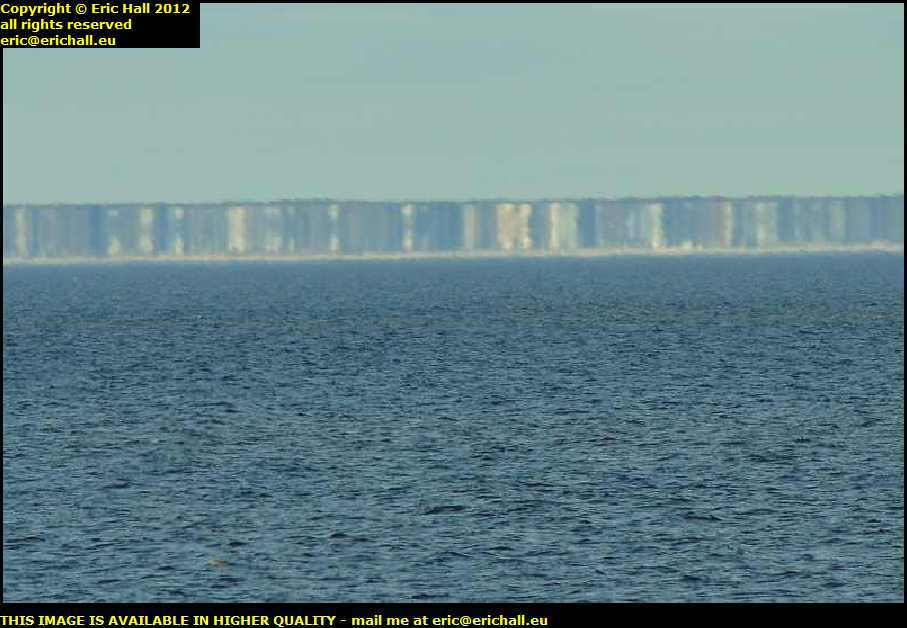
I did however manage to find a place to stop, and I'll talk about that in a minute, but my curiosity was attracted to the cliffs over on the far shore of Lac St Jean where we were yesterday, and the peculiar lines down them.
I thought at first that it might have been an optical illusion to do with the reflection of the light off the surface of the lake, or maybe clouds of condensation, but examining the photo later, I'm not sure. It might simply be haphazard trees in the foreground breaking up the view of the bare cliffs behind.
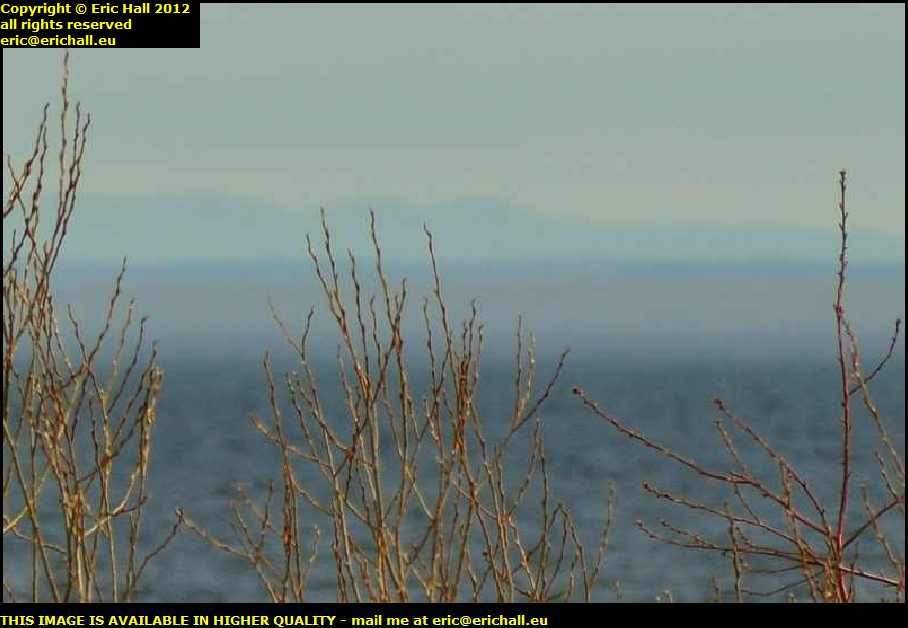
Another view from the same spot, taken with the telephoto lens, shows the south-eastern end of the lake. I'm heading around there later today to see what I can see.
In the background are the mountains which may well be those that I drove through early yesterday morning along the riviere Ste Marguerite. I'll be passing back that way, only on the other side of the Saguenay Fjord, on my way back to the St Lawrence.
Now I was going to tell you something about where I was, wasn't I? So as it happens, I'm in a settlement called Mashteuiatsh, and I hope that I have managed to spell this name correctly too. It is described as being the only Native community in the region, founded in 1856 and having 2000 inhabitants today.
Normally, I don't bother with reading the rubbish that the Tourist Information Board puts out, because it's in most cases designed for the gullible tourist. I spent 15 years or so of my life dealing with gullible tourists and so I understand all about Tourist Information leaflets. But the information put out by the TIB about Mashteuiatsh is well worth repeating.
So, crudely translated from the original French (you weren't expecting to see it in English were you? This is Quebec and there are pitifully few facilities on offer if you are a representative of that race that wickedly humiliated, oppressed and tortured the Quebecois 250 years ago) by Yours Truly -
"The Pekuakamiulnuatsh invite you to ... discover the native experience by a stay in their territory and nights under canvas. Holiday homes and campsites allow you to prolong your experience by watching the beauty of the sunsets on the lake"
"Boutiques of craftsmen bear witness to the richness of the culture which is still living on today. Take some time out to have a change of scenery and live in peace and tranquility. Let yourself be guided by the wisdom and knowledge of the local people"
Why I'm quoting all of that is because where I'm parked is on the car park of the local 7-11 shop and neighbouring post office. Both of these buildings are empty, abandoned and derelict.
On the outside is a sign saying to the effect that domestic violence is a dreadful thing and that there is a campaign "against the violence in our community". It lists several examples of violent incidents that have occurred here recently and warns against alcohol and drug abuse.
This is not the first time that I've heard of this kind of thing in a Native American community (or other aboriginal community elsewhere in the world). It's true that alcohol and drug abuse play a large part in domestic violence and this kind of thing and you can campaign about it as much as you like, but no-one in modern times has, in my experience, ever asked how the abuse of alcohol and drugs has arisen.
A great many studies were however made on this subject in the late-Victorian era in the desperate slums of darkest London. Generally-speaking (although not by any means in every case) they concluded that drugs and alcohol are employed as escapism, when someone's lot is so miserable that they see no other way out.
Unemployment amongst Native Americans and First-Nation Canadians is in many cases well above the national average and isn't likely to change. But why would this be so? The land and whatever lies on it or under it belonged originally to the autochtones and so when it comes to exploiting it, the native peoples whould be given the first opportunity to profit from it.
However they have been shunted aside, abandoned and ignored (it hasn't escaped my notice that I have yet to see any official Government sign written in any First-Nation language anywhere in Quebec), and it's all of this that has created the despair and abandonment that has led to drug and alcohol abuse.
If you are a habitué of the local police courts, you won't find too many gainfully-employed people charged with committing acts of violence, drunkenness, drug offences and the like - except of course in the UK where civilised society collapsed long ago. And when was the last time that you met a gainfully-employed, well-fed terrorist? The Devil makes work for idle hands.
General Crook
Maybe if the Quebec Tourist Board invited people to come to stay in the real world here at Mashteuiatsh with real families in a real First-Nation environment instead of an artificial tepee with costumed actors, and these people saw what life was really like in a modern First-Nation community by experiencing the despair and the helplessness, the violence and the drug abuse, things might just change.
But I'm far too much of a cynic ... "you, Eric? Perish the thought!" - ed ... to expect that to ever happen. We mustn't upset the tourists (unless of course they are the evil, wicked anglophones).
Anyway, that's enough of that for the moment. Abandoning yet another good rant, I decide to move on.
©